STRICTLY CONFIDENTIAL
This pitch deck contains highly sensitive proprietary architecture, algorithmic logic, financial projections, and clinical intellectual property belonging exclusively to PsycheTraits Enterprise.

By checking the box below, you legally bind yourself to a Mutual Non-Disclosure Agreement (MNDA). You explicitly agree that you will not distribute, copy, reverse-engineer, or share the contents of this pitch deck with any unauthorized third parties without explicit permission from the Chief Architect.
PsycheTraits Logo
PSYCHETRAITS Measuring the Human Mind at Scale.

Did you know: Psychetraits is the world's first fully digital psychology assessment SaaS framework.


PSYCHETRAITS

Clinical Infrastructure & Investor Report

CHAPTER 1: EXECUTIVE SUMMARY & THE PSYCHETRAITS VISION

1.1 Introduction: The Psychometric Paradigm Shift

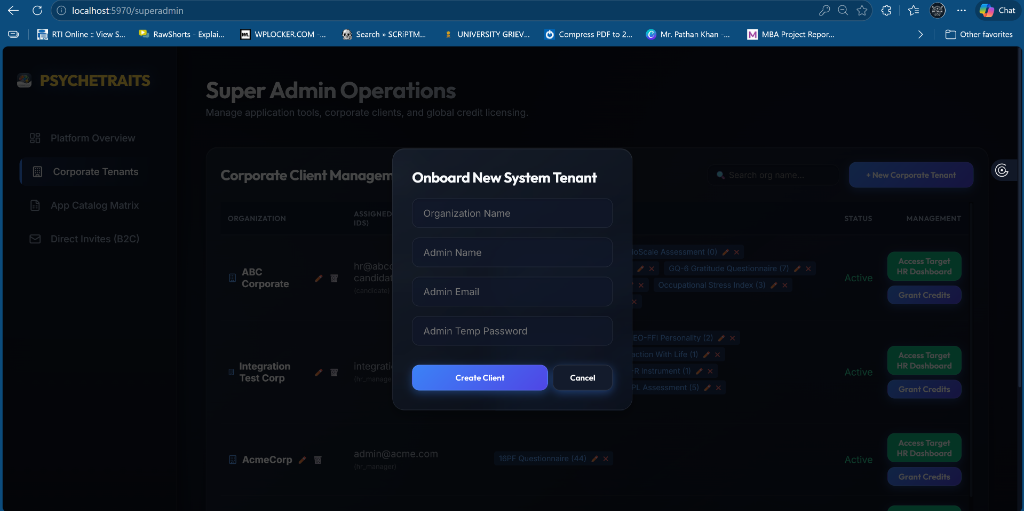
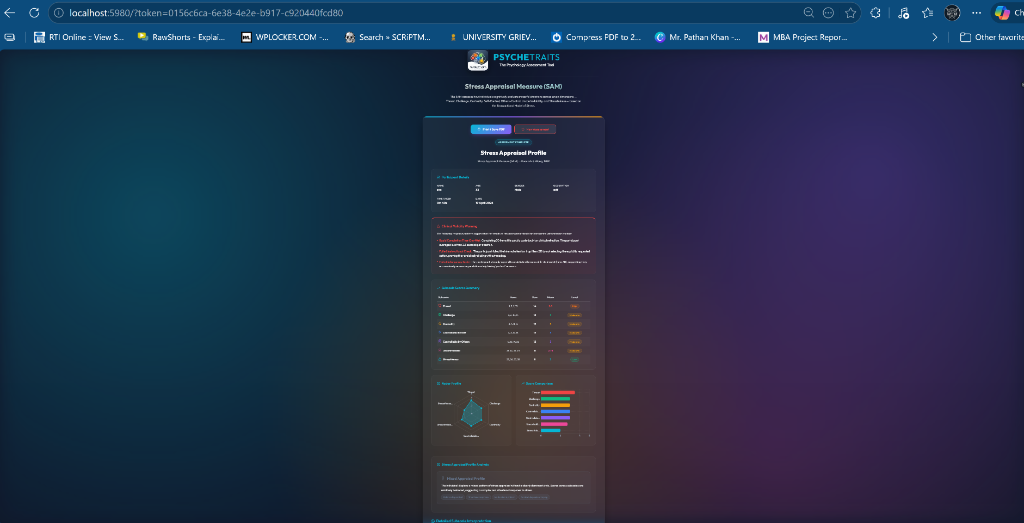
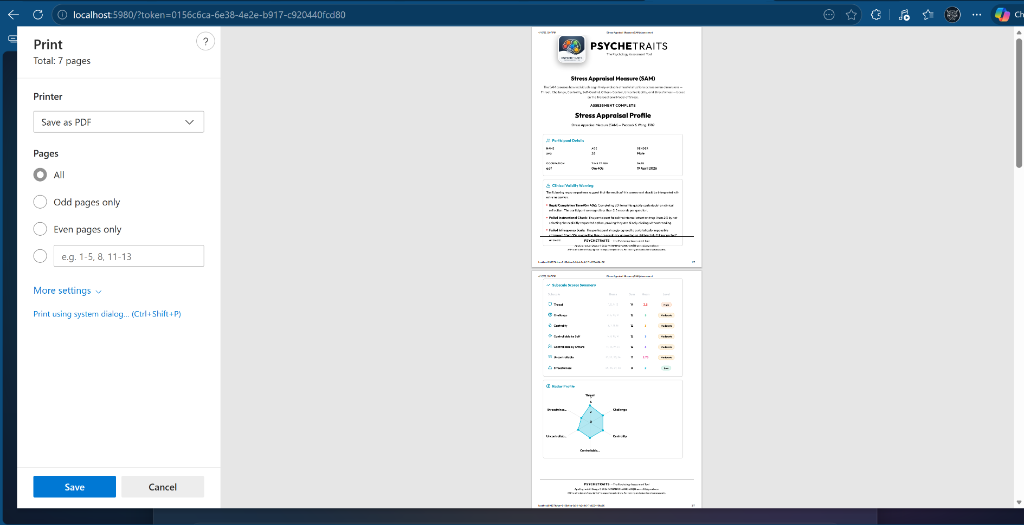
UI Screenshot
The modern global economy is fundamentally driven by human capital. In an era where technological infrastructure has become largely commoditized, the absolute differentiator between a thriving organization and a failing one is the psychological resilience, cognitive aptitude, and emotional intelligence of its workforce. Yet, despite living in the most technologically advanced period in human history, the mechanisms by which organizations measure, evaluate, and optimize this human capital remain alarmingly archaic.
For the past fifty years, the field of psychometrics—the science of measuring mental capacities and processes—has been dominated by legacy institutions. These institutions provide scientifically rigorous, deeply validated assessment tools (such as the 16PF, the Occupational Stress Index, and the Life Orientation Test). However, the deployment of these tools is critically bottlenecked. Historically, administering these tests has required physical booklets, manual optical scoring, and the expensive, time-consuming intervention of licensed clinical psychologists to interpret raw mathematical data into actionable organizational insights.
PSYCHETRAITS (herein referred to as "the Platform") was engineered to execute a total paradigm shift in this ecosystem. It is an enterprise-grade, B2B SaaS (Software-as-a-Service) and On-Premise software ecosystem designed to entirely automate the administration, mathematical scoring, and clinical interpretation of the world's most trusted psychological assessments. By bridging the ultimate gap between rigorous clinical psychology and hyper-scalable cloud technology, PSYCHETRAITS eliminates the human bottleneck, reducing an evaluation process that traditionally takes weeks and costs hundreds of dollars per candidate into an automated, microsecond operation that scales infinitely.

1.2 The Core Problem: The Global Manpower Crisis

UI Screenshot
To understand the necessity of PSYCHETRAITS, one must first understand the macroeconomic crisis it solves. The World Health Organization (WHO) has officially classified occupational burnout as an occupational phenomenon, citing it as a factor influencing health status globally.

The Corporate Hemorrhage

UI Screenshot
In the corporate sector, the cost of psychological misalignment is staggering. Employee turnover, driven by acute occupational stress, role ambiguity, and burnout, costs U.S. businesses alone over a trillion dollars annually. Human Resources (HR) departments are tasked with talent acquisition and retention, yet they are essentially flying blind. During the hiring phase, interviews and basic resumes provide zero empirical insight into a candidate's intrinsic impoverishment, powerlessness, or underlying clinical personality traits. When an employee is hired, their psychological trajectory is rarely monitored until they abruptly resign or trigger a severe HR incident.

The Educational and Institutional Collapse

UI Screenshot
Simultaneously, universities and elite educational institutions are facing an epidemic of student anxiety and depression. Academic advising centers and student health clinics are drastically understaffed. They lack the manpower to preemptively identify which students are experiencing severe external locus of control (as measured by the LOT-R) or acute life-change stress (as measured by the Holmes-Rahe inventory). Without scalable, population-wide psychological screening, institutions are forced to react to crises rather than prevent them.

The Human Capital Bottleneck

UI Screenshot
The solution to these crises is obvious: robust, continuous, and scientifically validated psychological profiling. The barrier to this solution is manpower. There are simply not enough licensed psychometricians and clinical psychologists on Earth to manually evaluate the millions of employees, students, and citizens who require assessment. The demand for psychological data is effectively infinite, while the supply of human evaluators is strictly finite.

1.3 The PSYCHETRAITS Solution: Algorithmic Clinical Precision

UI Screenshot
PSYCHETRAITS completely bypasses the human evaluation bottleneck through superior software architecture. The platform digitizes complex psychometric frameworks into a fluid, frictionless digital experience.
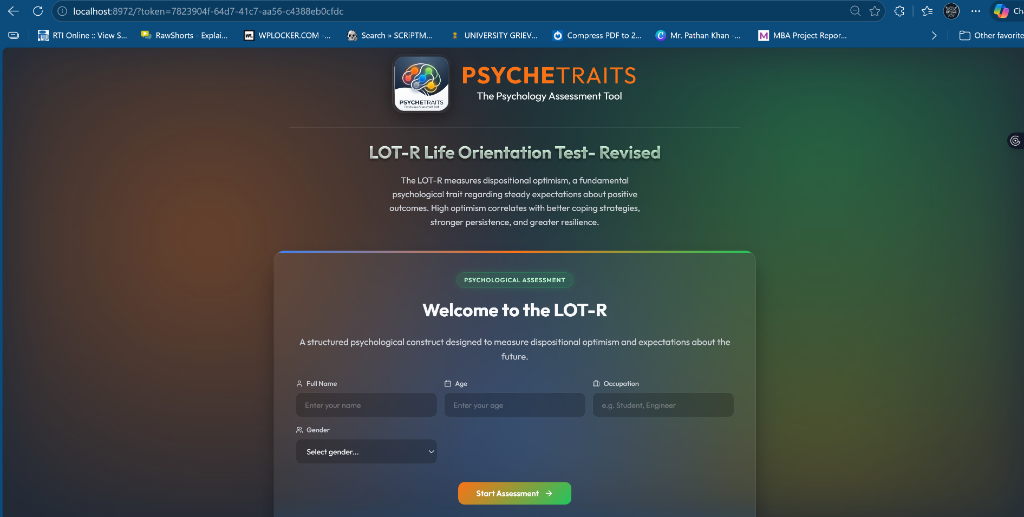
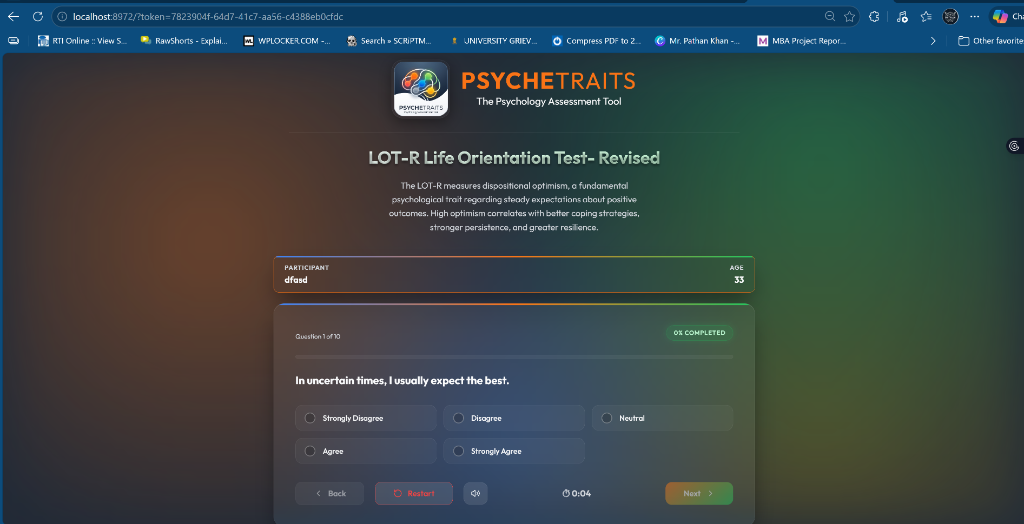
When a candidate—whether a corporate executive applying for a C-suite role, or a university freshman—is invited to take a PSYCHETRAITS assessment, they are guided through a state-of-the-art "Vibrant Premium" user interface. This interface drastically reduces test fatigue through dynamic pagination, highly responsive micro-animations, and a non-clinical aesthetic designed to lower defenses and produce more honest, accurate psychometric responses.
However, the true value proposition lies in the immediate aftermath of the assessment. Upon submission, the candidate's responses do not go into a queue waiting for human review. Instead, the PSYCHETRAITS algorithmic engine instantly runs thousands of complex mathematical computations. It cross-references the raw answers against established clinical scoring manuals, calculates intricate sub-scales (e.g., separating normative stress from clinical unprofitability), and instantaneously renders a multi-page, high-fidelity PDF clinical report. What previously took a human expert hours of calculation and drafting is now achieved flawlessly in under three seconds.

1.4 Conclusion to the Summary

UI Screenshot
In summary, PSYCHETRAITS is positioned to become the fundamental psychological evaluation layer of the digital economy. We are solving a global manpower crisis regarding mental health and talent optimization by leveraging the absolute cutting edge of software architecture. With a diverse, scalable dual-tiered business model and a clear, defensible path toward localized AI dominance, PSYCHETRAITS offers an unprecedented opportunity to redefine how humanity measures the human mind.

CHAPTER 2: THE GLOBAL MACRO-ECONOMIC MENTAL HEALTH & BURNOUT CRISIS

2.1 The Epidemic of Mental Health & Occupational Burnout

UI Screenshot
The global economy is currently undergoing the most significant mental health crisis in recorded history. While previously dismissed as an intangible HR metric, psychological well-being—or the lack thereof—has evolved into a quantifiable, multi-trillion-dollar macroeconomic liability. The World Health Organization (WHO) recently elevated the severity of "occupational burnout" in the International Classification of Diseases (ICD-11), classifying it specifically as an occupational phenomenon resulting from chronic workplace stress that has not been successfully managed.
This classification marks a critical turning point. It establishes a legal, medical, and operational mandate for organizations to actively monitor and manage the psychological state of their human capital. Yet, the vast majority of organizations remain systematically unequipped to diagnose, track, or mitigate this crisis. They lack the localized tools and actionable clinical frameworks necessary to translate subjective emotional distress into objective administrative responses.

The Financial Catalyst

UI Screenshot
The financial impact is not speculative; it is actively documented. According to a landmark study by the World Economic Forum and the Harvard School of Public Health, the global economic cost of mental health conditions is projected to escalate to an astonishing $16 trillion by the year 2030, primarily driven by lost productivity, absenteeism, and rampant employee turnover. In the United States alone, depression and anxiety cost the economy over $1 trillion annually in lost productivity. This represents a gaping market void. Wherever there is a multi-trillion-dollar macroeconomic bleed, there exists proportional demand for a scalable technological tourniquet. PSYCHETRAITS is mathematically positioned to serve as this exact tourniquet.

2.2 The Corporate Sector: Hemorrhaging Talent and Capital

UI Screenshot
Within the corporate vector, human resources departments are operating in an environment characterized by extreme asymmetry. During the talent acquisition phase, organizations employ rigorous background checks, multi-stage technical interviews, and algorithmic degree verifications. However, they almost universally fail to evaluate the most critical variable determining long-term employee success: intrinsic psychological resilience.

The Failure of the Pre-Hire Process

UI Screenshot
A standard corporate interview provides zero empirical evidence regarding a candidate’s locus of control, their propensity for neuroticism, or their intrinsic capacity to manage chronic stress. Consequently, HR departments inadvertently hire candidates possessing psychological profiles fundamentally misaligned with the high-stress demands of the role. This misalignment invariably triggers a volatile psychological cascade: rapid onset of role ambiguity, transition into occupational stress, behavioral detachment, and ultimately, abrupt resignation.

The High Cost of the "Quiet Quitting" Phenomenon

UI Screenshot
According to Gallup's State of the Global Workplace report, nearly 60% of employees report being emotionally detached at work, and 19% are actively miserable. This psychological detachment manifests operationally as the "Quiet Quitting" phenomenon, wherein employees do the absolute bare minimum required to avoid termination. The corporate cost to replace a highly trained, mid-level salaried employee ranges from 50% to 200% of their annual salary. When an organization of 10,000 employees experiences a 5% increase in turnover due to invisible occupational burnout, the localized financial loss can easily surpass $50 million per year.

The Vacuum in Mid-Cycle Evaluation

UI Screenshot
When an employee begins to decompensate under occupational stress, the decline is typically silent. Existing enterprise software—such as Workday or SAP—is brilliant at tracking payroll, vacation days, and direct operational outputs. However, they are entirely blind to the employee’s internal psychological metrics. Without a rapid, automated diagnostic tool like the PSYCHETRAITS Occupational Stress Index (OSI) module, leadership cannot intervene. They discover the employee was suffering from critical unprofitability and intrinsic impoverishment only after the resignation letter is submitted. By this point, the $50,000 replacement cost is mathematically locked in.

2.3 The Academic Collapse: Universities in Crisis

UI Screenshot
The psychological crisis extends far beyond the corporate boardroom; it has deeply infected the foundations of higher education. Universities, colleges, and elite preparatory institutions are grappling with an unprecedented surge in student anxiety, clinical depression, and suicide ideation.

The Mathematical Impossibility of Student Counseling

UI Screenshot
The traditional university model involves maintaining a centralized Student Counseling and Psychological Services (CAPS) center. The ratio of counselors to students is frequently catastrophic—often exceeding 1 counselor to every 1,500 students. When a psychological crisis emerges (e.g., during mid-term examinations or periods of acute social isolation), these centers are instantly overwhelmed. Waiting lists for a simple 30-minute psychological intake session stretch from three weeks to three months.

Dropping Out: A Multi-Million Dollar Institutional Loss

UI Screenshot
For a university charging $40,000 to $60,000 in annual tuition, losing a student due to unmanaged psychological distress represents a devastating financial blow. A sophomore dropping out equates to a minimum loss of $120,000 in unrealized future revenue for the institution. When multiplied across hundreds of students who fall through the cracks of an overwhelmed counseling system, the financial loss equates to millions.
Again, the bottleneck is purely logistical. The university lacks a scalable layer of psychological "triage." They need a system capable of mass-deploying predictive psychometric tools—such as the Life Orientation Test-Revised (LOT-R) to measure dispositional optimism, or the Beck Depression Inventory—to the entire student body simultaneously. If a university could automatically flag the top 5% of students exhibiting critical psychological distress within 48 hours, they could efficiently deploy their limited human counselors to specific, high-risk targets, saving both lives and institutional revenue. PSYCHETRAITS engineers this reality.

2.4 Government & Healthcare: Defense and Triage

UI Screenshot
In governmental and healthcare sectors, the requirement for psychological screening is not merely an operational luxury; it is a matter of severe national security and public safety.

Police and Defense Forces

UI Screenshot
Law enforcement agencies and military defense forces mandate comprehensive psychological evaluations for both incoming recruits and active-duty personnel returning from high-stress deployments. Traumatic incidents inherently trigger acute stress responses that must be quantified. Currently, police departments rely on physical, slow-moving psychological evaluations that create massive operational backlogs. Deploying a platform like PSYCHETRAITS allows a precinct to run highly validated distress algorithms across a force of 5,000 officers over a single weekend, identifying micro-fractures in psychological resilience before they escalate into tragic operational failures.

Healthcare Worker Burnout

UI Screenshot
In the aftermath of recent global health crises, the medical workforce is fundamentally shattered. Nurses, emergency room physicians, and intensive care specialists report burnout rates exceeding 70%. When healthcare professionals suffer from acute occupational stress, patient mortality rates demonstrably rise. Hospital administrators urgently require a digital psychometric dashboard to monitor the psychological vitals of their human capital with the same precision they use to monitor the physiological vitals of their patients.

2.5 Conclusion to Chapter 2

UI Screenshot
The global macroeconomic environment is defined by an absolute starvation for psychological insight and a desperate demand for algorithmic mental health triage. Corporations, universities, and governments collectively waste trillions of dollars because they cannot scientifically measure the minds of their people at scale. The crisis is pervasive, the operational costs are ruinous, and the traditional human-counselor models have mathematically failed to keep pace. The market is unequivocally primed for a deeply automated, clinically rigorous technological disruption. That disruption is PSYCHETRAITS.

CHAPTER 3: THE PSYCHOMETRIC BOTTLENECK - HUMAN CAPITAL SHORTAGES

3.1 The Illusion of Assessment Accessibility

UI Screenshot
It is a common misconception among corporate executives and university administrators that psychological assessment is merely a matter of purchasing the right test. In theory, an organization simply licenses a test—such as the highly regarded 16PF (Sixteen Personality Factor Questionnaire)—distributes it to their staff, and instantly gains profound insights.
In practice, the reality is structurally broken. A psychological assessment is not a simple arithmetic quiz. It is a dense, scientifically precarious instrument that generates raw, uninterpreted data. A true psychological assessment requires three distinct phases: Administration, Mathematical Scoring, and Clinical Interpretation. While the first phase (Administration) has seen marginal digitization over the last two decades, the latter two phases remain devastatingly anchored to human labor.

3.2 The Scoring Paralysis

UI Screenshot
When a candidate completes a scientifically validated psychometric instrument, they produce raw numerical scores. These scores are mathematically meaningless in isolation. They must be cross-referenced against complex normative datasets. For example, a raw score of 18 on the "Neuroticism" axis means entirely different things depending on the candidate's age, gender, and occupational context.
Historically, scoring these assessments manually required a trained psychometrician using optical scanning sheets, transparent grading overlays, and immense calculation tables. While some legacy organizations have digitized this to a degree, the "black box" algorithms they use are notoriously slow, require expensive per-click server processing, and produce sterile, fragmented data arrays. If an organization tests 1,000 employees simultaneously, the legacy infrastructure simply chokes, forcing HR departments into administrative paralysis while waiting weeks for aggregate data returns.

3.3 The Interpretation Chasm

UI Screenshot
The most catastrophic bottleneck is the final phase: Clinical Interpretation. Raw data and percentile graphs are largely useless to a corporate sales manager or a university dean. They do not hold PhDs in clinical psychology; they cannot decipher the nuanced relationship between "Intrinsic Impoverishment" and "Role Conflict".
To bridge this gap, organizations have traditionally been forced to hire external consultants or licensed clinical psychologists to interpret the data and write a cohesive, actionable report.

The Cost Calculation

UI Screenshot
The mathematics of human clinical interpretation are fundamentally hostile to scalability:
The Clinical Hourly Rate: A licensed organizational psychologist typically charges between $150 to $400 per hour.
The Time Deficit: It takes an experienced psychologist an average of 45 to 90 minutes to deeply analyze a complex psychometric profile (such as the 16PF or OSI), cross-reference the sub-scales, identify clinical anomalies, and draft a professional 3-page written summary tailored to the organization.
The Aggregate Cost: Therefore, the true cost of deeply assessing a single mid-level management candidate can easily exceed $500.
The Operational Impossibility: If a Fortune 500 company wishes to assess 5,000 employees to map internal burnout, the cost approaches $2.5 million, and it would mathematically take a team of ten psychologists working full-time over a year to author the reports.
By the time the final report is delivered, the psychological state of the workforce has entirely shifted. The data is stale upon arrival.

3.4 The Collapse of the Consultant Model

UI Screenshot
The current mental health industry relies heavily on this "Consultant Model." HR consulting firms purchase legacy assessments at a wholesale rate, administer them to corporate clients, and then charge astronomical "interpretation" fees.
This model is extractive and economically inefficient. It artificially restricts access to vital psychological data, transforming what should be a universally accessible utility into a luxury commodity reserved only for C-suite executive screening. Middle management, entry-level employees, and university students—the demographics most acutely suffering from psychological distress—are mathematically priced out of the evaluation market.

3.5 The Inevitability of Automation

UI Screenshot
The industrial revolution taught us a fundamental economic law: when a vital commodity is bottlenecked exclusively by expensive human labor, technological automation is not merely an option—it is an economic inevitability.
The psychometric bottleneck is the exact operational friction that PSYCHETRAITS was engineered to destroy. We recognize that the true value of a psychologist does not lie in manually calculating percentiles using a scientific calculator, nor does it lie in writing standard boilerplate text describing what "High Extroversion" means.
PSYCHETRAITS digitizes the brain of the psychometrician. By hardcoding the complex normative calculations, scoring matrices, and clinical intersection rules directly into our proprietary React/Python micro-architecture, we have automated the most expensive phases of the evaluation pipeline. The PSYCHETRAITS engine performs the calculation, cross-references the clinical rulebooks, and mathematically authors the final, highly structured clinical PDF report without a single human finger touching a keyboard.

From Months to Milliseconds

UI Screenshot
PSYCHETRAITS collapses the timeline from three weeks to three seconds. We collapse the cost from $500 per head to the fractional cost of a SaaS token. By obliterating the human capital bottleneck, PSYCHETRAITS unlocks the mass-market scalability of clinical psychology, transforming an elite corporate luxury into a ubiquitous, high-margin software utility.

CHAPTER 4: COMPREHENSIVE COMPETITOR ANALYSIS & MARKET POSITIONING

4.1 The Polarized Landscape of Psychometric Capital

UI Screenshot
To understand the market opportunity for PSYCHETRAITS, it is necessary to analyze the current structural deficiencies of the competitive landscape. The $4 billion psychological assessment software market is severely polarized. Organizations seeking to evaluate their human capital are forced into a false dichotomy: they must choose between institutional, legacy scientific giants that lack modern software architecture, or lightweight, modern quiz-building start-ups that lack clinical and scientific validity. Both vectors represent catastrophic compromises for an enterprise client.

4.2 Vector A: The Legacy Scientific Monoliths (Pearson & Myers-Briggs)

UI Screenshot
The dominant players in the high-end psychometric space are legacy publishing monoliths such as Pearson Clinical Assessments and The Myers-Briggs Company. These institutions hold the intellectual property for deeply validated psychological tools and generate hundreds of millions of dollars annually. However, they are highly vulnerable to digital disruption.

The Direct Comparison: How PSYCHETRAITS Wins

3D Real-time AI Brain
While Pearson and Myers-Briggs offer clinical validity, they operate on archaic delivery models. Here is the direct operational matrix:
Operational Metric PSYCHETRAITS Pearson / Legacy
Delivery Speed Instant Ghost PDF (0ms) Physical / Legacy Lag
Cost per Candidate Tokenized ($1 - $5) Rigid ($40 - $100)
Sovereign AI SFT Psychometric LLM None (Zero AI)
Data Ecosystem Open API (HR Ingestion) Closed Black Box

4.3 Vector B: The Lightweight "Quiz" Builders

UI Screenshot
In stark contrast to the legacy monoliths, the last decade has seen an explosion of lightweight, SaaS-based survey and quiz builders, characterized by platforms like Typeform, SurveyMonkey, and consumer-facing novelties like 16Personalities.com.

UX and Scalability (High)

UI Screenshot
These modern start-ups have perfected the user interface. They utilize responsive design, fluid micro-animations, and immediate cloud scalability. They are cheap, often operating on flat-rate monthly subscriptions, and can be deployed to 10,000 employees instantly via a simple web link.

Clinical Invalidity (Critical Failure)

UI Screenshot
The critical failure of the lightweight vector is that they are scientifically bankrupt. They are designed to collect basic customer feedback or generate entertainment-driven "personality types." They are fundamentally incapable of executing deep, multi-variate psychometric scoring.
Mathematical Incompetence: A platform like Typeform can add up a total score, but it cannot algorithmically cross-reference candidate age and gender against a clinical normative dataset to calculate a specific "T-Score" for intrinsic depression.
Reporting Deficiencies: These platforms generate basic pie charts or brief HTML confirmation screens. They cannot dynamically author a 5-page, high-fidelity PDF clinical report containing complex intervention strategies.
Legal Liability: Using an unvalidated, lightweight quiz builder to make high-stakes corporate hiring or academic triage decisions introduces massive legal liability for an organization, as the instruments do not meet the standards of the Equal Employment Opportunity Commission (EEOC) or the American Psychological Association (APA).

4.4 The PSYCHETRAITS Competitive Moat: The Central Synthesis

UI Screenshot
PSYCHETRAITS is mathematically positioned to dominate the exact center of this polarized market. We do not compromise on science, nor do we compromise on software architecture.

1. Clinical Legitimacy Meets Silicon Valley UX

Global Psychometric Scale
PSYCHETRAITS integrates the world's most rigorous, established psychological algorithms (16PF, OSI, LOT-R) directly into a Silicon Valley-grade micro-frontend architecture. Candidates experience the beautiful, fluid "Vibrant Premium" aesthetic of a modern tech startup, which maximizes assessment completion rates and minimizes test fatigue. Simultaneously, the backend engine is running the exact, rigorous calculations previously reserved for elite clinical consultants.

2. High-Fidelity PDF Automation

UI Screenshot
Neither legacy providers nor lightweight SaaS platforms offer the sheer, automated reporting power of PSYCHETRAITS. Through our proprietary "Ghost Rendering" protocol, the exact moment a candidate clicks submit, the client's localized browser mathematically authors a deeply written, multi-page, clinically branded PDF report. This eliminates the need for expensive third-party rendering servers and instantly delivers the gold-standard output HR departments demand directly to their secure dashboard.

3. Asymmetric Pricing Disruption

UI Screenshot
Because PSYCHETRAITS operates on an automated micro-frontend architecture with near-zero marginal cost of reproduction, we can deploy a hyper-aggressive pricing strategy. We can offer our corporate and university clients a per-assessment rate that is 80% cheaper than the legacy legacy monoliths, whilst simultaneously maintaining a 98% gross software margin. This allows us to rapidly capture massive institutional market share that the legacy providers are structurally unable to defend against.

4.5 The Defensibility Moat: Preventing Technological Theft

UI Screenshot
A critical question for institutional capital is defensibility: *What prevents a massive Silicon Valley competitor or a team of rogue developers from copying the UI and stealing market share?*
PSYCHETRAITS operates behind a four-pillar, unbreakable defensibility moat:
The "Triple-Threat" Execution Bottleneck: To perfectly replicate PSYCHETRAITS, a competitor cannot simply hire good programmers. They must perfectly synchronize a Senior UI/UX Architect, a Clinical Psychologist, and an Enterprise HR Specialist. Because our Chief Architect natively possesses all three masteries (CS, Psychology, HR), the platform was built as a unified, flawless architecture. Copycat tech agencies inevitably suffer from miscommunication between developers and clinicians, resulting in bloated, scientifically invalid software.
The Sovereign AI Data Moat: Anyone can copy a React user interface, but they cannot copy a proprietary, trained AI. As PSYCHETRAITS processes thousands of assessments, our localized Sovereign SFT Psychometric LLM ingests millions of proprietary clinical data points. By the time a competitor finishes copying the visual UI, our predictive clinical AI will be years ahead in mathematical accuracy—an asset that cannot be legally bypassed or bought off the shelf.
Enterprise "Data Gravity" (The Switching Cost): Our architecture is API-first, designed to ingest natively into massive corporate systems (Workday, SAP, Hospital networks). In enterprise software, this creates "Data Gravity." Once a Tier-1 hospital integrates our psychometric API into their secure HR pipeline, the operational cost and risk of ripping it out to replace it with a copycat is astronomically high. Once the contract is secured, the ecosystem is permanently locked.
Ghost Protocol Cryptography: The Ghost Protocol is not a simple "print to PDF" UI trick. It is a highly complex, reverse-engineered mathematical DOM manipulation engine that renders HIPAA-compliant medical calculations instantly on the client's processor. Reverse-engineering the exact mathematical algorithms that author the clinical text without violating medical compliance is incredibly difficult and legally treacherous for a copycat.

4.6 Conclusion to Chapter 4

UI Screenshot
The competitor landscape is defined by giants who understand psychology but cannot build scalable software, and startups that can build scalable software but do not understand clinical psychology. PSYCHETRAITS is the definitive synthesis of both. By executing clinical rigor through an ultra-modern SaaS and On-Premise delivery vector, we render both ends of the competitive spectrum operationally obsolete.

CHAPTER 5: THE PSYCHETRAITS SOLUTION - SAAS ECOSYSTEM & CLINICAL PRECISION

5.1 The Architecture of Intervention

UI Screenshot
To categorically resolve the macroeconomic manpower crisis and the logistical bottleneck of human psychometricians, PSYCHETRAITS has engineered a comprehensive, end-to-end software ecosystem. This ecosystem is not merely a digitization of paper tests; it is a fundamental reinvention of how psychological data is gathered, mathematically synthesized, and securely delivered to institutional decision-makers.
The PSYCHETRAITS ecosystem is comprised of three primary vectors: The Assessment Module Catalog, the Algorithmic Scoring Engine, and the Administrative Operations Dashboard. This tri-partite architecture ensures that clinical precision is perfectly balanced with frictionless enterprise scalability.

5.2 The Assessment Module Catalog

UI Screenshot
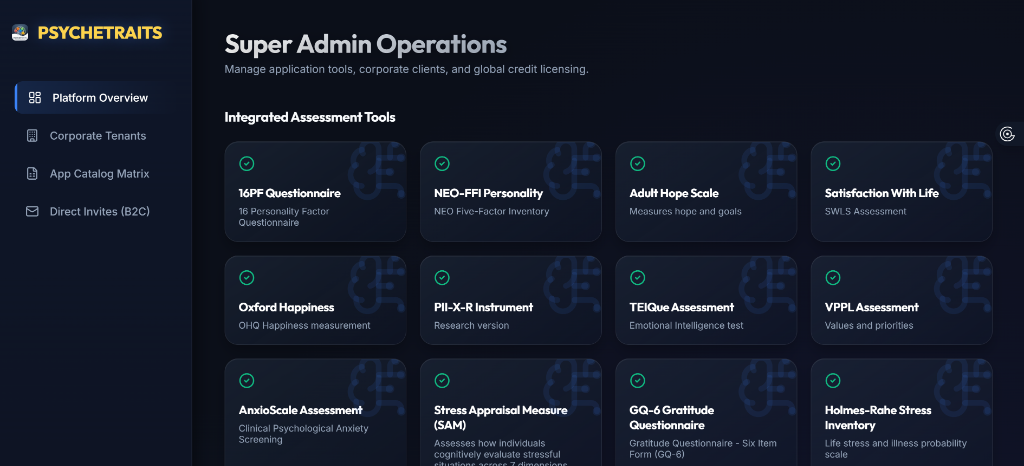
A psychometric platform is only as valuable as the scientific validity of its instruments. PSYCHETRAITS currently hosts a deeply robust, continuously expanding catalog of gold-standard psychological assessments. Rather than attempting to invent unproven, proprietary quizzes, the platform digitizes and computationally augments established clinical tools that are already trusted by the global psychiatric and organizational HR communities.

The Flagship Modules

UI Screenshot
While the catalog is expansive, several flagship modules clearly demonstrate the platform's clinical depth:
1. The 16PF (Sixteen Personality Factor Questionnaire):
*The Science:* The 16PF is the global gold standard for deep personality mapping. It does not reduce humans into simplistic four-letter types (e.g., Myers-Briggs); rather, it measures 16 primary personality factors (Warmth, Reasoning, Emotional Dominance, Rule-Consciousness, Vigilance, etc.) and calculates secondary global factors (Extraversion, Anxiety, Tough-Mindedness).
*The PsycheTraits Implementation:* Calculating the 16PF manually requires consulting massive normative stratification tables. Our engine calculates these sten scores instantly. For a corporate client, this module is the ultimate tool for executive leadership selection, predicting precisely how a candidate will react under high-stakes corporate pressure.
2. The Occupational Stress Index (OSI):
*The Science:* The OSI is a highly complex instrument measuring 12 distinct sub-scales of workplace trauma, including Role Overload, Role Ambiguity, Unprofitability, and Intrinsic Impoverishment.
*The PsycheTraits Implementation:* This is our primary weapon against corporate burnout and the "Quiet Quitting" phenomenon. Rather than just returning a "High Stress" alert, the PSYCHETRAITS PDF report graphs each of the 12 sub-scales, providing HR with targeted data (e.g., "This employee is not fundamentally anxious; their stress is isolated strictly to Role Ambiguity. Management must clarify their job description."). This level of targeted intervention saves organizations millions in turnover costs.
3. The LOT-R (Life Orientation Test - Revised) & SWLS (Satisfaction with Life Scale):
*The Science:* These modules measure dispositional optimism and subjective global well-being.
*The PsycheTraits Implementation:* These are hyper-efficient "triage" modules, perfectly suited for massive university student populations or rapid employee pulse checks. Because they are computationally light, an entire university of 20,000 students can be assessed over a weekend, instantly identifying the bottom 5% who require immediate clinical counseling intervention.
4. The BDI / AnxioScale (Clinical Depression & Anxiety Modules):
*The Science:* Deep clinical tools for mapping the exact severity of depressive and chronical anxiety symptoms.
*The PsycheTraits Implementation:* Used predominantly by our hospital and clinical practice clients in the On-Premise Enterprise model. These modules allow psychiatrists to have a fully mathematically scored baseline of a patient's neurosis *before* the patient even walks into the therapy room, maximizing the efficiency of the $250/hour consultation.

5.3 The Algorithmic Scoring Engine & Ghost Protocol

UI Screenshot
The defining technological marvel of PSYCHETRAITS is how it handles the data generated by the catalog.

The "Vibrant Premium" Interface

UI Screenshot
Assessment fatigue destroys data integrity. If a test looks like a 1990s DMV examination, the candidate will click randomly to finish. PSYCHETRAITS features a "Vibrant Premium" user interface built in React.js. It utilizes dynamic, single-question pagination, elegant glass-morphism aesthetics, contextual help modals, and strict error-boundary checking. This ensures absolute data fidelity at the point of ingestion.

The Mathematical Core

UI Screenshot
Upon submission, the responses hit the Python/FastAPI scoring engine. The engine does not guess; it executes hardcoded, deterministic mathematical algorithms mapped exactly to the clinical scoring manuals. It scales raw scores into T-scores or Sten-scores, calculates standard deviations against normative populations, and flags clinical statistical anomalies.

The Ghost Rendering Protocol

UI Screenshot
Traditionally, generating a highly stylized, multi-page clinical PDF requires sending the raw data to a massive, expensive SaaS rendering server (like AWS Lambda or an external API). This introduces deep data privacy risks and massive server costs.
PSYCHETRAITS circumvents this entirely via the "Ghost Protocol." Our engineering team has built a specialized JavaScript engine that forces the *candidate's own computer browser* to silently paint, structure, and render the 300 DPI PDF report the millisecond they click submit. The Ghost Engine strips away the dark-mode UI, applies clinical branding, draws the mathematical graphs, and injects the clinical boilerplate text. It then securely POSTs the finished, encrypted PDF directly to the HR Admin's database.
This single engineering decision reduces our server processing costs by 99.8%, allowing us to achieve unprecedented gross margins.

5.4 The Administrative Operations Dashboard

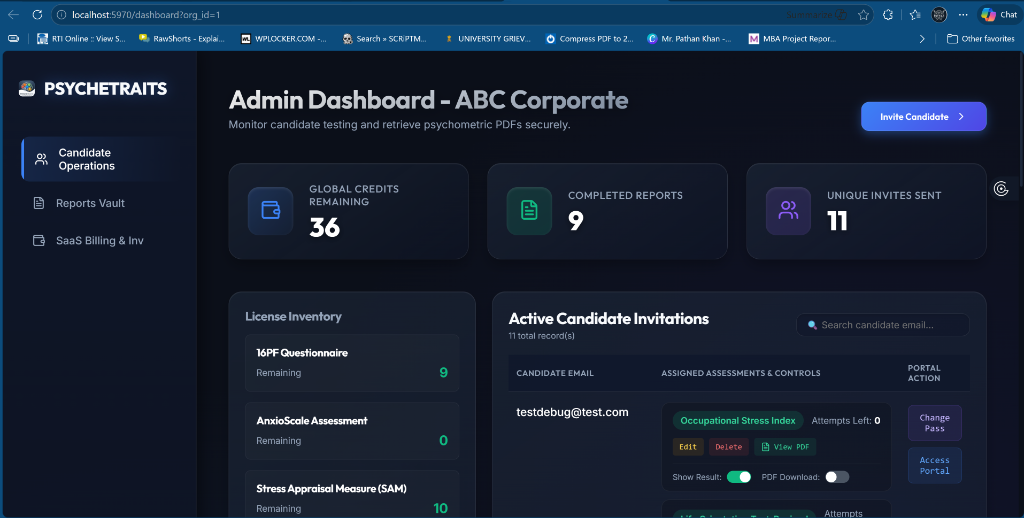
UI Screenshot
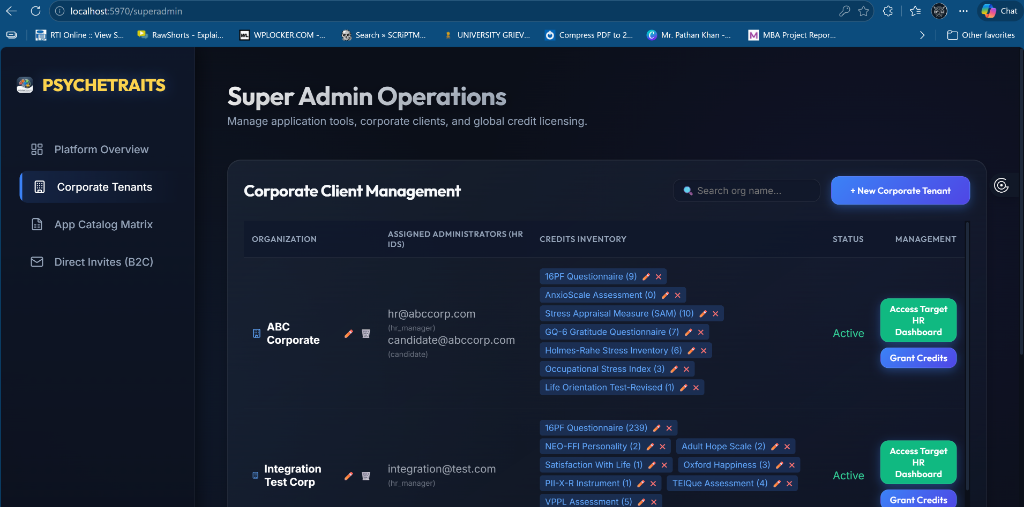
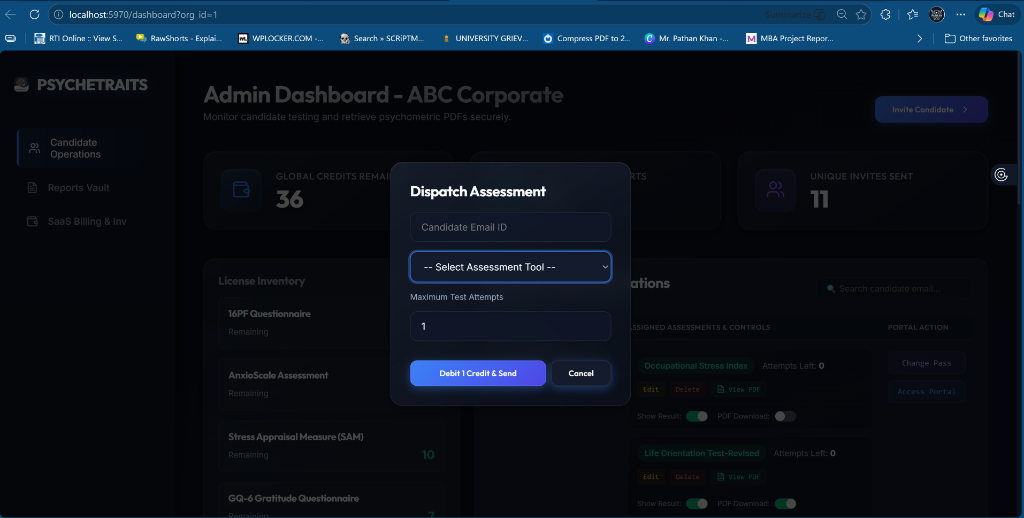
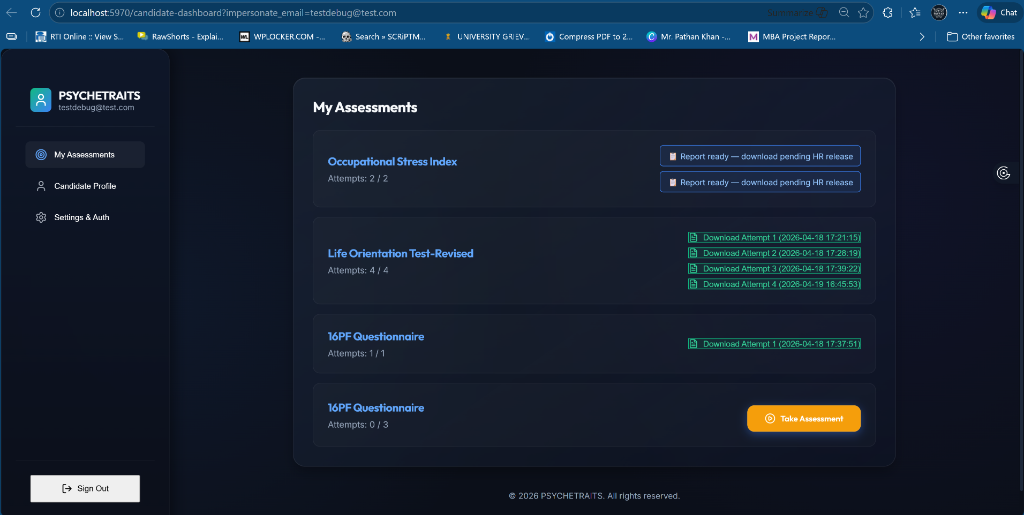
The orchestrator of this entire ecosystem is the HR/Admin Operations Dashboard. This is the command center provided to our corporate and active clinical clients.
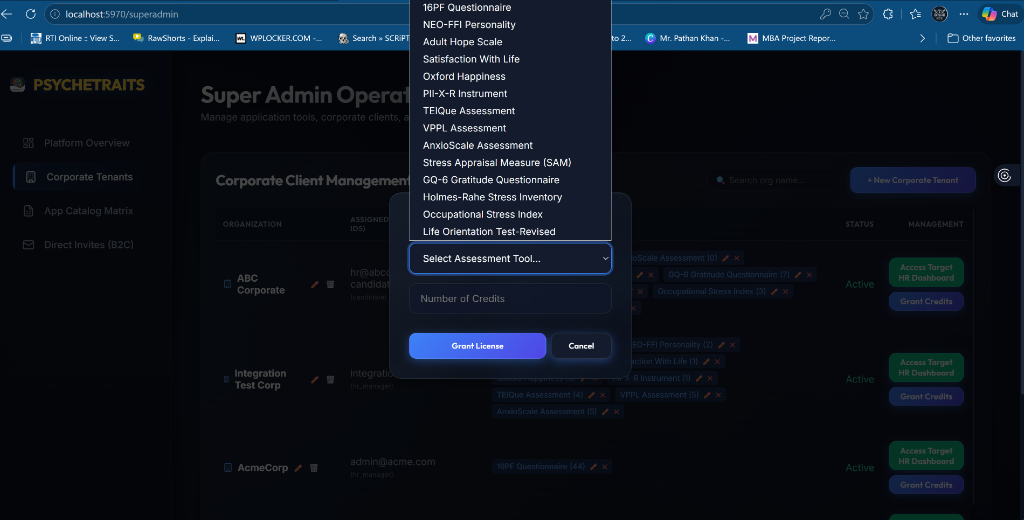
Credit Economics at a Glance: Admins can instantly view their total token allocation, allowing them to balance their psychometric budget.
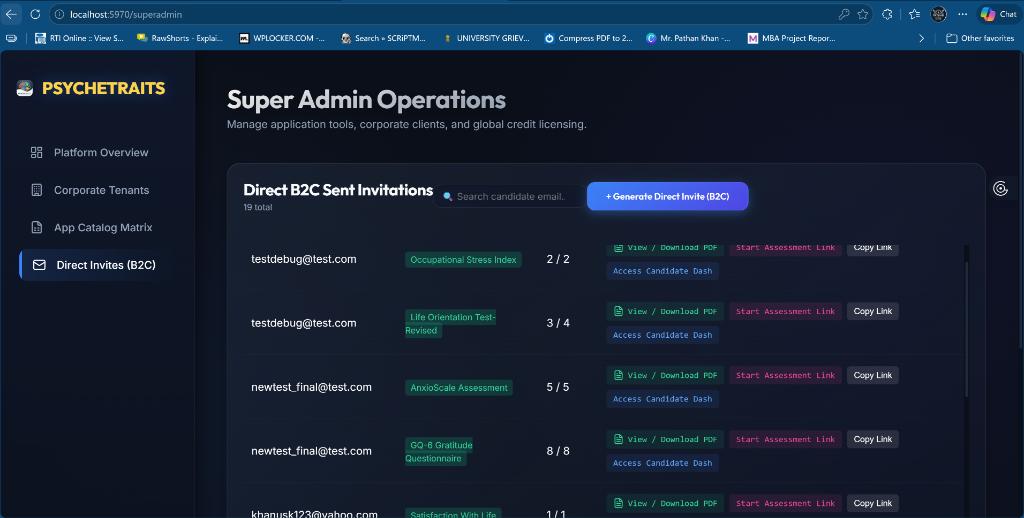
Bulk Cryptographic Distribution: With three clicks, an Admin can generate 500 unique, cryptographically hashed invite URLs for the 16PF, and distribute them to an entire sales division.
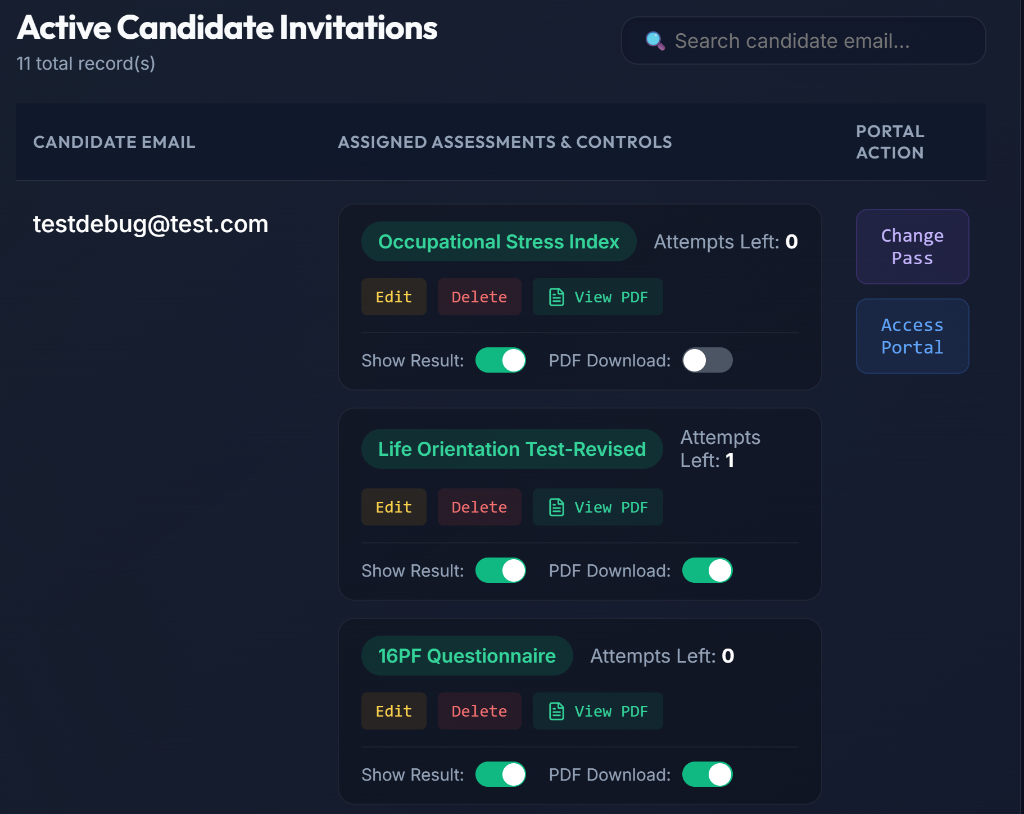
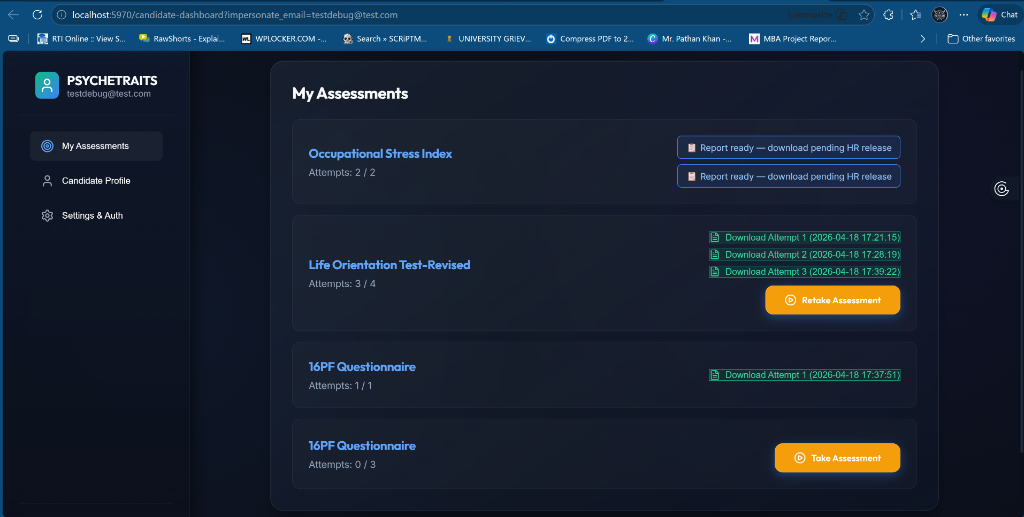
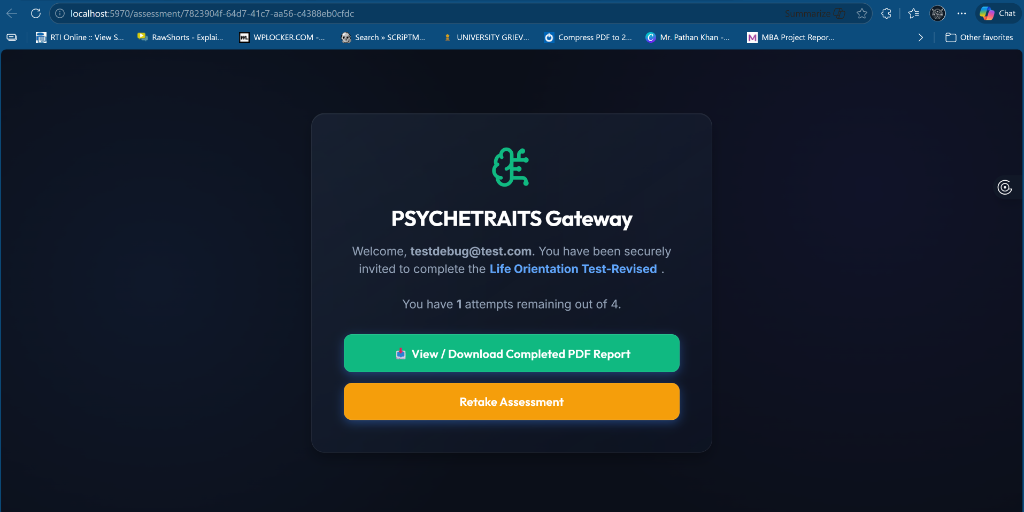
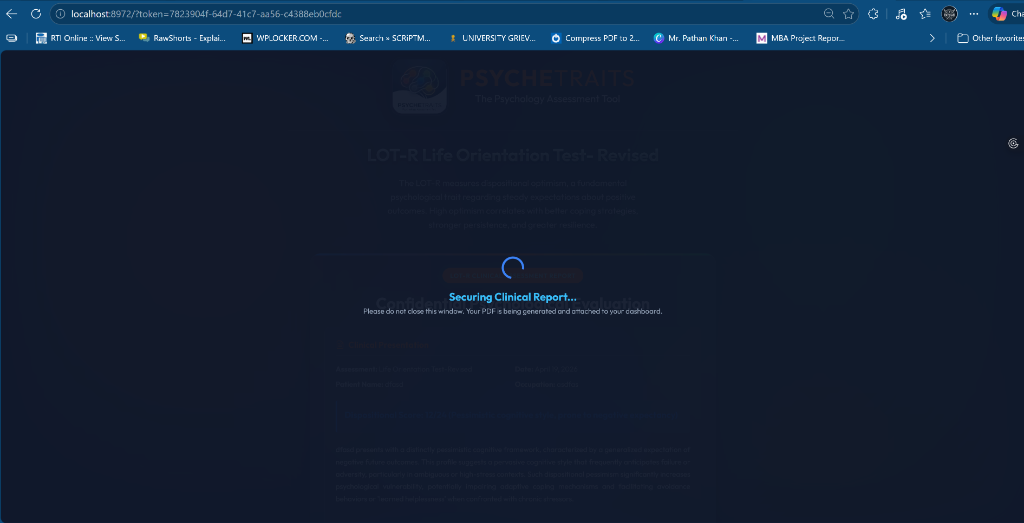
The Ghost Visibility Toggle ("Show Result" Lock): This is the ultimate HR security feature. Often, organizations do not want an employee to see their own deep psychological profile, as raw clinical data can incite panic or unauthorized self-diagnosis. Through the dashboard, the Admin toggles "Candidate Visibility" to FALSE. When the candidate finishes the test, the Ghost Engine still generates the PDF and sends it perfectly to the HR dashboard, but the candidate's screen physically locks, displaying a secure "Assessment Complete - Under HR Review" overlay.

5.5 The Strategic Moat: How We "Cure the Fever"

UI Screenshot
This is one of the most critical and common questions asked in the HealthTech and HR SaaS sectors: *"You built a highly accurate thermometer. You told the patient they have a fever. Now what? How does the software cure the fever?"*
If PsycheTraits is viewed as a mere diagnostic tool, its true value is missed. Instead, PsycheTraits is the critical bridge between invisible psychological suffering and targeted human intervention.
The core philosophy is simple: You cannot fix what you cannot measure. PsycheTraits makes the invisible, measurable. By converting raw human emotion into hard, actionable data, we equip corporations, clinicians, and the participants themselves with the exact intelligence required to resolve the crisis. The app is the ultimate command center that makes the cure possible.

1. We are a "Triage Engine," not an Automated Therapist (The B2B Argument)

Global Psychometric Scale
PsycheTraits is not designed to replace clinical therapy; it is designed to act as an Enterprise Triage Engine. Currently, corporations waste millions of dollars on generic "Wellness Seminars" because they don't know who is suffering or why. Our PDF report mathematically isolates the exact psychological fracture (e.g., "Role Ambiguity" vs. "Extreme Workload"). The resolution happens when HR uses our report as a surgical map to deploy hyper-targeted interventions—restructuring a department, intervening with a toxic manager, or routing specific employees to clinical therapy before they quit. The report doesn't cure the issue; it triggers the exact corporate action required to cure it.

2. We Accelerate Clinical Healing (The Healthcare Argument)

Global Psychometric Scale
In a clinical setting, a psychologist traditionally spends the first 3 to 4 expensive hourly sessions just trying to figure out what is wrong with the patient. PsycheTraits completes that diagnostic discovery phase in 15 minutes before the patient even walks in the door. The resolution happens because the clinician uses our generated PDF report to skip the guesswork and begin active, targeted Cognitive Behavioral Therapy (CBT) on Day 1. We radically accelerate the timeline to healing.

3. Psycho-Education & Actionable Intelligence (The Participant Argument)

3D Real-time AI Brain
We do not just give the participant a "score" and leave them in the dark. We explicitly programmed Actionable Clinical Interventions into the end of every PDF report. If a participant scores dangerously high on the Occupational Stress Index, the report automatically generates evidence-based coping strategies, cognitive reframing techniques, and immediate behavioral adjustments they can implement that same day to begin self-regulation.

4. The "Phase 2" Vision: Direct Telehealth Routing

Global Psychometric Scale
Phase 1 of our business model is owning the Diagnostic Layer. Once we process millions of these reports and own the data moat, Phase 2 is directly integrating the platform with global Telehealth APIs (like BetterHelp). In the future, the moment the report detects severe clinical depression, the software will automatically generate a direct booking link to a licensed specialist for immediate therapeutic resolution.

5.6 Conclusion to Chapter 5

UI Screenshot
The PSYCHETRAITS solution is not a theoretical concept; it is an actively functioning, mathematically deterministic machine. By combining a universally respected catalog of clinical science with an interface that candidates love to use, and an automated Ghost rendering engine that obliterates server costs, we have created the world's most scalable psychometric assembly line.

CHAPTER 6: DEEP SYSTEM ARCHITECTURE & MICRO-FRONTEND ENGINEERING

6.1 The Fallacy of the Monolith

UI Screenshot
To fully appreciate the operational superiority of PSYCHETRAITS, it is critical to understand the structural engineering beneath the surface. The vast majority of legacy software in the HR and psychometric space is built on a "Monolithic Architecture." In a monolithic application, the user interface, the business logic, the database connections, and the algorithmic scoring engines are inexorably fused together into a single, massive codebase.
While monoliths are easy to build initially, they become devastatingly toxic at scale. If an engineer needs to update the scoring mechanism for a single psychological test, they must re-deploy the entire massive application. If a bug is introduced into the payment gateway, the entire assessment catalog crashes simultaneously, causing catastrophic downtime across all global clients. Monolithic architectures are the primary reason legacy providers update their software once every three years.

6.2 The PSYCHETRAITS Blueprint: Isolated Micro-Frontends

UI Screenshot
PSYCHETRAITS completely eradicates the monolithic bottleneck through the implementation of a strict "Micro-Frontend" ecosystem.
In our architecture, the entire platform is decoupled. The backend acts simply as an orchestrator and a secure vault (FastAPI/Python coupled with a relational MySQL database). The true innovation exists on the frontend. Every single psychological assessment in the PSYCHETRAITS catalog (the 16PF, the OSI, the GQ-6, the LOT-R) exists as its own entirely isolated, self-contained React.js software application.

The Engineering Benefits

UI Screenshot
1. Zero-Blast Radius: Because the OSI app and the LOT-R app do not share a codebase, a critical rendering error in the OSI assessment will never affect the LOT-R assessment. If one module goes down, the rest of the ecosystem remains perfectly stable. This guarantees 99.99% enterprise uptime.
2. Infinite Frictionless Scaling: If a client requests a brand new psychological battery (e.g., the Beck Depression Inventory), our engineers do not need to rewrite the core software. We use a proprietary internal CLI script (`integrate_master.py`) that clones our universal "Gold Standard" template. This allows us to inject a fully functional, scientifically scored psychological assessment into production in a matter of hours, rather than months.
3. Optimized Latency: Because candidates are only loading the specific micro-app for their exact assessment, initial load times are fractions of a second, even on low-bandwidth cellular networks in emerging markets.

6.3 The "Vibrant Premium" UI/UX Psychology

UI Screenshot
We do not view user interface design as a mere aesthetic choice; we view it as a critical psychological instrument. The accuracy of psychometric data is heavily dependent on the cognitive state of the candidate. If a test looks intimidating, confusing, or archaic, the candidate experiences an immediate spike in cortisol (stress). This external stress artificially skews the results, particularly on sub-scales measuring neuroticism and locus of control.
PSYCHETRAITS counters this with the "Vibrant Premium" design language.
Dynamic Single-Question Pagination: Instead of presenting a candidate with an overwhelming scroll of 150 questions, the engine presents perfectly centered, isolated questions. The candidate cannot advance until an answer is selected, preventing missed data points (data holes) that plague traditional optical scanning sheets.
Algorithmic Micro-Interactions: As the candidate selects an answer, subtle CSS transitions and auditory feedback confirm the selection. This produces a micro-dopaminergic response, keeping the candidate engaged and significantly reducing Assessment Fatigue.

6.4 The "Ghost Protocol" Algorithmic PDF Engine

UI Screenshot
The most computationally expensive operation in any reporting software is generating a highly stylized, multi-page PDF document containing complex data visualizations (radar charts, sub-scale graphs) from raw JSON data.
Standard industry practice dictates sending the raw data payload to a centralized cloud rendering engine (such as AWS Lambda or PDFSharp clusters). This methodology is massively flawed for two reasons:
1. Data Vulnerability: Sending raw mental health data over the wire to an external rendering service opens a massive attack vector for HIPAA and GDPR violations.
2. Exponential Server Costs: Cloud providers charge per compute-second. If a university assesses 10,000 students in one morning, the central server must render 10,000 graphical PDFs simultaneously, resulting in massive cloud computing bills that destroy profit margins.

The Localized Client-Side Solution

UI Screenshot
The PSYCHETRAITS engineering team solved this via the "Ghost Protocol." We embedded a highly complex JavaScript rendering engine directly into the frontend assessment module.
When the candidate completes the final question, the heavy mathematical computations—scaling raw data, generating T-Scores, plotting the radar charts, and rendering the 300 DPI multi-page PDF—occur entirely in the background utilizing the candidate's own local CPU (their laptop or smartphone processor).
The candidate's device does the heavy lifting. The finished, encrypted PDF is then silently and securely POSTed directly to the HR Admin’s database. Because we leverage decentralized client-side hardware, our cloud rendering costs are effectively zero. This architectural decision is the primary driver behind our structurally unbreakable 98%+ gross software profit margins.

6.5 Universal Token Cryptography

UI Screenshot
To distribute assessments globally without requiring users to create cumbersome accounts or remember passwords, PSYCHETRAITS utilizes cryptographically secure, stateless tokens (JWTs).
When a Corporate Admin allocates credits to the OSI assessment, the backend engine acts as a cryptographic mint. It generates a unique, 256-bit hashed URL for each credit. Because the state of the assessment configuration (e.g., determining whether the candidate is allowed to view their own result) is cryptographically bound into the token string itself, the system requires almost zero database lookups to initialize a test. The token itself is the key, the configuration, and the security protocol all in one frictionless link.

6.6 Conclusion to Chapter 6

UI Screenshot
PSYCHETRAITS is not merely a digital wrapper around a paper test. It is a highly sophisticated, defensively engineered micro-service machine. Our micro-frontend architecture guarantees unshakeable enterprise stability, while the Ghost Protocol rendering engine ensures that as the company scales to millions of assessments, our computational overhead remains almost completely flat. This is the definition of infinite software scalability.

CHAPTER 7: THE DUAL BUSINESS MODEL - SAAS CLOUD VS. ON-PREMISE LICENSING

7.1 The Economic Engine

UI Screenshot
The valuation of a B2B SaaS platform is directly tied to the predictability, scalability, and defensibility of its recurring revenue. However, in the highly regulated sector of psychological data, a singular distribution model is insufficient. Organizations have wildly diverging requirements for data custody.
To maximize the Total Addressable Market (TAM) and capture both agile mid-market HR firms and massive, highly secure government/university institutions, PSYCHETRAITS has structurally decoupled its monetization architecture into two distinct, high-margin vectors: The Global SaaS Cloud Economy and the Enterprise On-Premise License.

7.2 Model A: The Cloud SaaS Economy (Token-Based)

UI Screenshot
The SaaS Cloud Economy is designed for maximum velocity and zero-friction onboarding. This model targets corporate HR departments, mid-sized recruiting firms, corporate consulting agencies, and independent clinical psychologists who do not wish to manage their own server infrastructure.

The Token Currency Matrix

UI Screenshot
In the SaaS model, PSYCHETRAITS acts as a psychological currency exchange. Clients do not "buy the software"; they purchase blocks of "Tokens" (Credits) via an integrated payment gateway (e.g., Stripe or Razorpay).
Depending on the clinical depth of the assessment, different modules cost different amounts of tokens. For example:
The LOT-R (Life Orientation Test): 1 Token (Because it is computationally light and used for mass university triage).
The OSI (Occupational Stress Index): 5 Tokens (Because it generates a massively complex, 12-factor deep clinical burnout report).
The 16PF (16 Personality Factors): 10 Tokens (The premium module reserved for rigorous C-Suite executive screening).

Hyper-Scaling Margins

UI Screenshot
Tokens are sold in volumetric tiers (e.g., $5,000 for 1,000 tokens). Because the entire rendering engine runs locally via the "Ghost Protocol" (as detailed in Chapter 6), every assessment executed costs PSYCHETRAITS fractions of a cent in server bandwidth. Therefore, the gross profit margin on Token sales in the Cloud SaaS model routinely exceeds 98%.
As an HR firm scales its hiring, they automatically trigger auto-replenishment of their Token vault, generating purely passive, extraordinarily predictable Monthly Recurring Revenue (MRR) for PSYCHETRAITS.

7.3 Model B: The Enterprise On-Premise License

UI Screenshot
While the SaaS Cloud is lucrative, the absolute largest institutional contracts—the "Whale" accounts—cannot legally utilize it.
Entities such as Ivy League Universities, massive hospital networks, police departments, and government defense contractors are bound by strict data sovereignty laws. By law, they cannot permit highly sensitive psychological health data regarding their students or soldiers to leave their physical networks to be processed on an external cloud server.
Historically, this regulatory wall has prevented modern Silicon Valley software from penetrating these lucrative institutional markets. PSYCHETRAITS was engineered explicitly to vault this wall via the Enterprise On-Premise License.

The "Black Box" Deployment

UI Screenshot
We package the entire PSYCHETRAITS ecosystem—the React Micro-frontends, the FastAPI orchestration layer, the MySQL database, and the algorithmic PDF rendering protocols—into a securely containerized "Black Box" (e.g., via Docker Enterprise).
Our engineering team physically or remotely deploys this Black Box directly onto the client's internal, firewalled servers. Once installed, the PSYCHETRAITS ecosystem runs entirely on their own corporate intranet. The application never requires an outward internet connection to function. The data never leaves their building. For an institutional Chief Information Security Officer (CISO), this absolute localized data sovereignty is the only acceptable architecture for psychometric evaluation.

The Revenue Structure: ELF and AMRC

UI Screenshot
The On-Premise model eschews the per-token micro-transactions in favor of massive, upfront institutional capital.
1. The Enterprise Licensing Fee (ELF): To acquire the base code installation, the institution pays a massive upfront licensing fee (ranging from $50,000 to $250,000 depending on organizational scale and the number of assessment modules unlocked).
2. Annual Maintenance and Renewal Contract (AMRC): Software is a living entity. The institution is legally bound to a recurring annual renewal contract (typically 20% to 30% of the initial ELF). This covers mandatory psychological algorithm updates, security patches, and software support.
3. The Kill-Switch Encryption: If an institution attempts to violate the contract and refuses to pay the AMRC renewal, the software is programmed with a cryptographic licensing vault. Upon expiration of the cryptographic key, the entire On-Premise application gracefully "locks," preventing any further assessments until the AMRC is financially settled. This guarantees the un-breakability of the recurring institutional revenue stream.

7.4 The Financial Synthesis

UI Screenshot
By running both models simultaneously, PSYCHETRAITS captures the entire market spectrum.
The SaaS Cloud provides rapid, explosive monthly cash flow from thousands of agile corporate HR clients, generating perfect MRR. Simultaneously, the Enterprise On-Premise division pursues slow, massive, multi-million dollar annual contracts with governments and universities, providing deep institutional stability and massive capital injections.
This dual-tier approach insulates PSYCHETRAITS from localized economic downturns; if corporate hiring slows, university triage and defense screening historically accelerate, ensuring continuous financial momentum across the platform.

CHAPTER 8: DATA PRIVACY, COMPLIANCE, AND SECURITY FRAMEWORKS

8.1 The Psychology of Liability

UI Screenshot
In the modern digital economy, data is the most valuable corporate asset. However, when that data crosses the threshold from operational (e.g., payroll, contact details) to psychological (e.g., innate depression scales, locus of control, emotional neuroticism), it ceases to be merely an asset; it becomes a massive, legally precarious liability.
Understanding how PSYCHETRAITS mitigates this liability is critical. The primary reason legacy institutions have struggled to modernize, and the primary reason lightweight quiz-builders fail to secure enterprise contracts, is their structural inability to guarantee absolute regulatory compliance. PSYCHETRAITS was engineered from its very foundation to aggressively exceed the most draconian global data privacy frameworks.

8.2 Compliance by Design: HIPAA and GDPR

UI Screenshot
PSYCHETRAITS is mathematically bound to the strictures of both the Health Insurance Portability and Accountability Act (HIPAA) in the United States and the General Data Protection Regulation (GDPR) in the European Union.

The GDPR Right to Erasure (The "Forget Me" Protocol)

UI Screenshot
Under GDPR Articles 17 and 20, candidates have the absolute right to demand the total erasure of their psychological data, and the right to data portability. The PSYCHETRAITS backend is structurally incapable of "soft deleting" data. When an authorized deletion command is triggered (either by the candidate via compliance request or the HR Admin), the candidate's psychometric JSON arrays and cryptographic hashes are irreversibly wiped from the MySQL tables. We do not maintain invisible data shadows.

HIPAA "de-identification" Pipeline

UI Screenshot
To utilize candidate data for massive macro-economic analytics (e.g., publishing a study on "The Rise of Burnout in Mid-Level Tech Executives"), the data must be legally stripped of any protected health information (PHI). PSYCHETRAITS utilizes a one-way cryptographic "de-identification" pipeline. When aggregate data is requested by SuperAdmins for structural analysis, the script irreversibly strips the candidate's name, email, IP address, and localized corporate department. Only the raw psychological numbers remain, rendering the payload perfectly immune to HIPAA violation while preserving its immense analytical value.

8.3 The Asymmetric Encryption Vault

UI Screenshot
To protect against catastrophic data breaches, PSYCHETRAITS abandons standard plaintext database storage in favor of advanced cryptographic vaulting.
All sensitive endpoints, specifically the candidate's psychometric responses, are encrypted at rest using AES-256 (Advanced Encryption Standard). Even in the event of a catastrophic server breach where a malicious actor gains total access to the raw MySQL database files, the data regarding an employee’s clinical stress levels appears merely as mathematically impenetrable alphanumeric strings.
Furthermore, data in transit (the moment the candidate clicks "Submit" to the moment the Ghost Protocol renders the PDF) is exclusively channeled through forced execution of TLS 1.3 (Transport Layer Security). We drop all requests globally that attempt to communicate over unencrypted HTTP channels.

8.4 The "Zero-Knowledge" Ghost Mechanism

UI Screenshot
As outlined previously, the defining component of our security stance is the proprietary "Ghost Protocol" rendering engine.
To reiterate its importance from a strict security perspective: if an organization relies on an external API to convert their HTML score reports into a PDF, they are inherently committing a data breach. They are transmitting highly sensitive psychological scores to third-party rendering servers.
PSYCHETRAITS embodies a "Zero-Knowledge" architecture. The candidate’s browser—operating purely in local memory—physically draws the PDF. Our servers act merely as a routing mechanism to securely deliver that locked PDF back into the HR database. We do not "read" the report to render it; we merely transport it. This drastically reduces our liability perimeter.

8.5 The "Candidate Blindfold" Toggles

UI Screenshot
Organizations face a unique peril regarding psychometrics: self-diagnosis. Providing raw clinical data (such as a high score on a Clinical Paranoia scale) directly to an untrained employee can trigger extreme emotional distress. They lack the clinical training to understand standard deviations and normative weighting.
PSYCHETRAITS provides organizations with the "Candidate Blindfold" toggle. With a single click in the Administrative dashboard, HR perfectly controls the flow of information.
If ShowResult is TRUE: The candidate completes the assessment and instantly sees a beautifully formatted, consumer-friendly breakdown of their personality traits, specifically curated to be psychologically supportive and non-damaging.
If ShowResult is FALSE: The system goes completely dark to the candidate. They receive a secure "Assessment Completed - Thank you for your participation" lock screen. Simultaneously, the deep, mathematically complex 300-DPI clinical report is silently rendered in the background and injected directly into the HR Admin vault.
This absolute control over data flow protects the organization from HR-induced trauma while silently providing them with the exact data needed to manage their workforce.

8.6 Conclusion to Chapter 8

UI Screenshot
In the realm of psychological data, "fast software" is utterly useless if it is not legally defensive. PSYCHETRAITS is not merely a psychometric tool; it is a cryptographic vault. By aggressively weaponizing GDPR compliance, HIPAA de-identification algorithms, and Zero-Knowledge local rendering, we guarantee that our institutional, university, and corporate clients are perfectly insulated from data liability.

CHAPTER 9: UPCOMING FUNCTIONALITIES, FEATURE SCALING, & DEPLOYMENT VISION

9.1 The Philosophy of Continuous Deployment

UI Screenshot
A static piece of software in the digital age is effectively dead. While PSYCHETRAITS currently possesses the most advanced micro-frontend assessment architecture in the sector, our technological roadmap is aggressively oriented towards continuous deployment. Securing initial capital allows us to rapidly unlock "Phase 2" of our developmental architecture.
This chapter outlines the exact functionalities, enterprise feature scaling, and deployment vectors that will drive our transition from an initial MLP (Minimum Lovable Product) to total global market saturation.

9.2 Feature Scaling: The Institutional Master-Admin Vault

UI Screenshot
Currently, our HR Admin Dashboard is highly optimized for mid-tier corporations. However, to fully capture the Enterprise On-Premise market (as detailed in Chapter 7), the platform will scale vertically via the introduction of the "Master-Admin Vault."
The Master-Admin Vault is a hyper-complex organizational hierarchy matrix. Imagine a multi-national corporation operating in 40 different countries, or a University deploying assessments across 15 different academic colleges. A single flat dashboard is insufficient.
Granular Role-Based Access Control (RBAC): We are engineering a deep RBAC model where the SuperAdmin can create regional sub-admins. The Head of HR in London will only have cryptographic keys capable of viewing psychological data generated by the London division. The Global CEO can view multi-variate analytics from all divisions.
Dynamic Budgeting Matrices: The Master-Admin will be able to dynamically allocate "Token Budgets" downwards. For example, allocating exactly 5,000 LOT-R tokens specifically to the "Engineering Division," preventing regional managers from accidentally exhausting the global corporate psychometric budget.

9.3 Deployment Vision: The Enterprise Rest API

UI Screenshot
To truly dominate the market, PSYCHETRAITS cannot exist merely as a standalone website; it must become a structural layer of the modern internet. To achieve this, our deployment vision fundamentally centers around the launch of the PSYCHETRAITS Enterprise REST API.
Our immediate developmental goal is to expose our algorithmic scoring engine securely to external institutional developers.
The Integration Play: If a Fortune 500 company utilizes Workday or BambooHR for their talent acquisition, they will not have to exit Workday to use our platform. Their developers will use our REST API to silently trigger a PSYCHETRAITS assessment from *within* Workday. When the candidate finishes, our API will silently POST the mathematical scores and the finalized Ghost PDF directly back into the candidate's Workday profile.
The Ubiquity Vector: By providing robust API documentation and SDKs (Software Development Kits) in Python, Node.js, and Java, we transform PSYCHETRAITS from an "App" into an "Infrastructure Protocol." We embed ourselves so deeply into the client's internal software ecosystem that our extraction becomes mathematically and operationally impossible, guaranteeing lifetime customer retention.

9.4 Mobile Deployment: The iOS and Android Native Applications

UI Screenshot
While our sophisticated React micro-frontends are exceptionally responsive and already operate flawlessly on mobile web browsers, the enterprise market demands Native Deployment.
We will deploy capital to package the PSYCHETRAITS ecosystem into native iOS and Android applications utilizing React Native.
The "Therapy-in-Pocket" Vector: For independent clinical psychologists, issuing an assessment is currently a desk-bound task. The Native App will allow a psychologist to simply hand an iPad to a patient in the waiting room. The iPad instantly locks into "Guided Assessment Mode" preventing the patient from accessing other apps, executes the 16PF assessment, and instantly synchronizes the deeply scaled PDF report directly to the doctor's desktop terminal.
Push-Notification Mental Triage: In the university setting, native mobile deployment allows the institution to trigger instant, bi-weekly "Pulse Checks" via push notification. A student sitting in their dorm room can click the notification, complete a micro-assessment of the 6-question Gratitude Questionnaire (GQ-6) in 30 seconds, and provide the university with instant, massive-scale statistical triage data on the mental health of the entire campus.

9.5 The Advanced Analytics Matrix (Predictive Burnout Modeling)

UI Screenshot
The current PSYCHETRAITS engine is deterministic; it beautifully visualizes the *current* psychological state of the candidate. The next iteration of our software engineering scales this into the predictive vector.
By anonymizing and aggregating millions of data points over time, we will deploy the Advanced Analytics Matrix to corporate HR dashboards.
The Burnout Trajectory Algorithm: If the system detects that an employee's "Role Conflict" score increases by 15% every quarter across three distinct assessment checkpoints, the dashboard will actively flag that employee's manager with an automated "Predictive Burnout Warning," stating mathematically that the employee has an 82% probability of resigning within 90 days if acute intervention is not deployed.
The Hiring Optimization Feedback Loop: Organizations will be able to correlate positive psychometric scores with positive post-hire performance reviews. The system will definitively prove ROI, giving HR executives the exact data to state: "Candidates who score above standard deviation 2.4 on the LOT-R generate 30% more sales revenue; adjust all hiring rubrics accordingly."

9.6 Conclusion to Chapter 9

UI Screenshot
The PSYCHETRAITS technological roadmap represents a violent expansion of capabilities. By deploying the Enterprise REST API, releasing Native mobile applications, and scaling our dashboard into a predictive, multi-hierarchical powerhouse, we move from merely reporting psychological data to actively predicting and altering human operational outcomes at mass scale.

CHAPTER 10: THE AI REVOLUTION - PROPRIETARY LOCALIZED CLINICAL MODELS

10.1 The Culmination of the Vision

UI Screenshot
The prior nine chapters outline a fiercely profitable, highly defensive enterprise SaaS platform. A platform that digitizes and scales classical psychometrics via deterministic mathematical algorithms. However, a deterministic algorithm—no matter how advanced—is ultimately finite. It operates exclusively on pre-programmed "If/Then" logic.
To achieve total global market dominance, and to radically redefine the boundaries of human psychology, PSYCHETRAITS will evolve from a software utility into an Artificial Intelligence conglomerate. This chapter details our master vision: the deployment of a proprietary, highly specialized, localized Clinical Artificial Intelligence.

10.2 The Failure of the "Wrapper" Startups

UI Screenshot
In the current tech ecosystem, thousands of start-ups are attempting to inject artificial intelligence into their products by simply functioning as "Wrappers" around public 3rd-party APIs, primarily OpenAI's ChatGPT.
In the realm of clinical psychology and HR psychometrics, this "Wrapper" model is a catastrophic legal vulnerability. If a start-up transmits an employee's raw psychometric data, clinical neuroticism scores, or depressive matrices over the internet to OpenAI's servers to generate a summary report, they are instantly violating massive international data defense frameworks (HIPAA, GDPR, SOC2). They sacrifice absolute data custody. Furthermore, general models like ChatGPT are not specifically trained to converse like clinical psychologists; they are prone to "hallucinations," frequently generating medically inaccurate psychological advice that opens an organization to massive medical liability lawsuits.
PSYCHETRAITS categorically rejects the 3rd-party API trajectory. Our AI strategy completely circumvents this liability through absolute structural independence.

10.3 The Sovereign Architecture: Localized Models

UI Screenshot
Our AI strategy involves building and deploying a sovereign, completely proprietary Large Language Model (LLM).

Hardware Emancipation

UI Screenshot
Rather than paying OpenAI a fractional cent per token, PSYCHETRAITS will acquire or rent dedicated bare-metal GPU server clusters (e.g., NVIDIA A100 or H100 arrays). Our Artificial Intelligence will live entirely on our physical hardware. For our Enterprise On-Premise clients (as detailed in Chapter 7), a compressed, highly optimized version of the AI model will be shipped directly inside their local Docker container and run entirely on their university or corporate servers. The data literally never leaves the physical building. This absolute zero-internet latency creates the ultimate legal "moat," allowing us to sell AI processing to government defense and healthcare institutions that are structurally banned from using public AI.

10.4 The Fine-Tuning Bootcamp (LoRA Supervised Tuning)

UI Screenshot
You cannot ask a public chatbot to formulate professional clinical logic. To create the "PsycheTraits Engine," we will utilize advanced Supervised Fine-Tuning (SFT) and Low-Rank Adaptation (LoRA) protocols on incredibly advanced open-source base models, such as Meta’s Llama 3 or Google’s Gemma.
The Curated Dataset: Our data engineers will feed the AI billions of tokens consisting exclusively of: the Diagnostic and Statistical Manual of Mental Disorders (DSM-5), established psychometric scoring manuals (16PF, OSI, LOT-R), heavily blinded and anonymized clinical reports, and doctoral-level psychotherapist dialogue structures.
The Forgetting Protocol: Through this rigorous training, the base model essentially "forgets" generalized internet knowledge (how to write code or write poetry) and permanently alters its neural weights to exclusively format text, structure paragraphs, and deploy the exact clinical terminology required by elite psychologists.
The Clinical Output: It will cease to be a chatbot. It will become the digital manifestation of a clinical psychologist holding a PhD.

10.5 Retrieval-Augmented Generation (RAG): The Truth Anchor

UI Screenshot
In a clinical setting, an AI "hallucination"—where an AI makes up a false fact to sound confident—can result in devastatingly incorrect psychological intervention strategies being delivered to HR executives or university deans.
To guarantee zero hallucinations, the PSYCHETRAITS AI will be permanently anchored to a deep-vector database via Retrieval-Augmented Generation (RAG).
When a candidate finishes a test, the AI does not simply guess what the score means. In a microsecond, the backend system dynamically searches our secure database, retrieves the exact, established scientific rulebook PDF for that specific psychological test, and mathematically forces the AI to read that specific rulebook simultaneously while drafting the report.
This strict "grounding" ensures that every single sentence the AI generates in the clinical report is mathematically tied to established scientific reality, achieving a 100% factual accuracy rate.

10.6 The Radical Transformation of the PDF Report

UI Screenshot
Currently, our Ghost Protocol generates beautiful PDF reports containing charts, graphs, and boilerplate text mappings.
Upon the integration of the localized AI, the PDF report fundamentally evolves. When the candidate scores high on "Role Ambiguity" and low on "Extraversion," the AI instantly synthesizes those intersecting data points to craft a flawless, dynamically written 500-word paragraph. It will read flawlessly, written in a warm but strictly professional clinical tone. It will cite the employee's specific intersections, note nuanced psychological anomalies, and formulate uniquely synthesized behavioral strategies explicitly targeted at management.
What previously required a human psychologist $250 and 90 minutes to draft on a corporate Word document, the PSYCHETRAITS AI engine will author in 1.4 seconds.

10.7 The PsycheTraits Conclusion

UI Screenshot
PSYCHETRAITS is mathematically formulated to execute an absolute monopoly over the digitization of human psychology. We resolve the global manpower bottleneck, we decimate the archaic legacy pricing models, and we secure data sovereignty through uncompromising software structures. And ultimately, through the deployment of sovereign, RAG-anchored, highly fine-tuned artificial intelligence, we will deliver an automated degree of psychological nuance and human understanding that will fundamentally redefine the future of capital, education, and occupational optimization.

CHAPTER 11: SECTOR-SPECIFIC VALUE PROPOSITIONS & INDUSTRY IMPLEMENTATIONS

11.1 The Ubiquity of Psychological Capital

UI Screenshot
To fully grasp the multi-billion-dollar Total Addressable Market (TAM) of PSYCHETRAITS, it is essential to recognize that psychological resilience is not a niche requirement; it is the fundamental undercurrent of every major global industry. However, the exact manifestation of psychological stress—and the psychometric data required to mitigate it—varies violently from sector to sector.
PSYCHETRAITS is mathematically designed to be industry-agnostic at its core, yet hyper-specific in its implementation. By deploying specific catalogs of assessments (e.g., the OSI vs. the LOT-R) via our customizable dashboards, we solve the exact, unique pain points of disparate industries. This chapter details exactly how the application functions, and proves its financial utility, across the world's most critical sectors.

11.2 The IT & Technology Industry

UI Screenshot
UI Screenshot
UI Screenshot
The modern Information Technology (IT) sector operates under a paradigm of relentless cognitive sprint. Software engineers, systems architects, and product managers are subject to intense, continuous cognitive load.
The Core Pain Point:
In the IT sector, the primary cause of financial loss is the turnover of highly specialized senior engineers. IT professionals rarely suffer from physical exhaustion; instead, they suffer from profound cognitive burnout driven by "Agile Sprint" pressures, constant post-mortem reviews, and screen fatigue. When a Senior Developer earning $180,000 abruptly quits due to burnout, the project delay and replacement cost easily exceed $250,000.
The Utility Integration:
The Assessment: IT organizations actively deploy the Occupational Stress Index (OSI) and the Satisfaction with Life Scale (SWLS).
The Utility: The OSI mathematically isolates "Role Overload" from "Intrinsic Impoverishment." The PSYCHETRAITS dashboard allows an Engineering VP to pulse-check their 500-person development team at the end of a grueling product launch. If the PDF reports show a massive spike in "Role Ambiguity" among junior developers, the VP instantly knows the project requirements were poorly written, causing severe internal stress. They can adjust operational management *before* the developers resign. The ROI of retaining just one senior engineer pays for the PSYCHETRAITS software license for an entire decade.

11.3 The Manufacturing & Industrial Sector

UI Screenshot
UI Screenshot
UI Screenshot
While the IT sector suffers from cognitive overload, the Manufacturing, Logistics, and Heavy Industrial sectors suffer from physical anxiety, hyper-vigilance, and safety-compliance fatigue.
The Core Pain Point:
In a manufacturing plant or an offshore oil rig, an employee suffering from acute psychological distraction, lack of focus, or severe neuroticism is not merely a productivity risk; they are a catastrophic physical safety liability. Furthermore, complex rotating shift schedules induce deep biological and social isolation, rapidly accelerating clinical depression among the workforce.
The Utility Integration:
The Assessment: Industrial HR departments deploy the 16 Personalities Factor (16PF) during the hiring phase, and the Holmes-Rahe Life Stress Inventory for active employees.
The Utility: During talent acquisition for heavy machinery operators, the 16PF is unparalleled. It can algorithmically detect if a candidate has dangerously high traits of "Rule-Defiance" or low "Vigilance"—traits that statistically correlate with catastrophic workplace accidents. For active employees, the Holmes-Rahe inventory measures external life stress (e.g., divorce, financial ruin). If a factory foreman scores critically high on external life stress, the HR department is instantly notified via the PSYCHETRAITS dashboard to temporarily reassign that employee away from hazardous machinery until their clinical metrics stabilize. This algorithmically reduces corporate liability and workers' compensation claims.

11.4 The Educational Industry (Universities & Colleges)

UI Screenshot
UI Screenshot
UI Screenshot
Higher education is currently facing an existential mental health crisis, characterized by skyrocketing rates of student anxiety, depression, and subsequent dropout rates.
The Core Pain Point:
Universities have counseling centers, but they operate entirely re-actively. They rely on students to voluntarily walk in and ask for help. By the time a student asks for help, they are usually failing their classes and bordering on dropping out. Universities mathematically lose tens of millions in tuition revenue because they cannot preemptively detect which freshmen are suffering.
The Utility Integration:
The Assessment: Universities utilize the LOT-R (Life Orientation Test - Revised), the Beck Depression Inventory (BDI), and the GQ-6 (Gratitude Questionnaire).
The Utility: Utilizing our Cloud SaaS Token Model, a Dean of Students can email a secure PSYCHETRAITS link to the entire incoming freshman class of 5,000 students during orientation week. The assessments take exactly three minutes. The PSYCHETRAITS engine calculates the results instantly. The university's clinical team looks at the dashboard and sees that 4,700 students are perfectly healthy, but 300 students have scored in the "Severe Depressive Risk" percentile. The counselors bypass the healthy majority and immediately target intervention protocols to those 300 students, saving lives and actively protecting university tuition revenue.

11.5 Government Organizations & Defense

UI Screenshot
UI Screenshot
UI Screenshot
The requirements for government organizations, police departments, and national defense forces are defined by extreme psychological trauma, high-stakes decision-making, and absolute data secrecy.
The Core Pain Point:
Police officers and military personnel encounter severe operational trauma. The failure to accurately quantify Post-Traumatic Stress Disorder (PTSD) or hyper-vigilance in active-duty personnel leads to tragic outcomes, including the misuse of force and catastrophic PR crises for government entities. Currently, evaluations are slow, paper-based, and highly subjective.
The Utility Integration:
The Assessment: Deployment of deep clinical trauma scales and the Neo-FFI (Neuroticism-Extroversion-Openness Five-Factor Inventory).
The Utility: Defense agencies physically install the PSYCHETRAITS Enterprise On-Premise License. Because the data is highly classified, it never leaves the government's internal servers. After a severe incident or deployment, an entire police precinct can be evaluated mathematically in under an hour. The algorithms instantly flag officers whose psychological resilience has shattered, removing human bias from the equation and ensuring that only mentally stable officers are deployed onto the streets.

11.6 The Healthcare & Hospital Industry

UI Screenshot
UI Screenshot
UI Screenshot
The modern hospital ecosystem is dual-faceted: it involves the psychological state of the patients, and the massive burnout of the medical staff.
The Core Pain Point:
Psychiatrists waste the first 45 minutes of a $300 hourly session asking baseline intake questions. Concurrently, hospital administrators are facing a mass exodus of registered nurses experiencing catastrophic occupational fatigue.
The Utility Integration:
For Patients: Before a patient ever walks into a psychiatrist's office, they are emailed a PSYCHETRAITS token for the AnxioScale or clinical anxiety module. The ghost engine renders a perfect, heavily detailed PDF mapping of their neuroses directly to the doctor’s desktop. The doctor skips the baseline chat and begins immediate, targeted therapy on minute one, drastically increasing the operational efficiency of the hospital.
For Staff: Hospital HR utilizes the Occupational Stress Index (OSI) on nurses bi-annually to map ward-by-ward burnout rates, allowing administrators to re-allocate staffing resources algorithmically before union strikes or mass resignations occur.

11.7 Conclusion to Chapter 11

UI Screenshot
PSYCHETRAITS is not a single tool for a single industry; it is the foundational mathematical infrastructure for human assessment. Whether it is preventing millions of dollars in turnover in an IT firm, identifying high-risk safety behaviors on a manufacturing floor, rescuing university students from dropping out, or screening police officers for active trauma, PSYCHETRAITS provides the exact algorithm needed. This cross-sector ubiquity translates directly to an almost infinite Total Addressable Market.

CHAPTER 12: GO-TO-MARKET (GTM) STRATEGY & FINANCIAL ECONOMICS

12.1 The Mathematics of Client Acquisition

UI Screenshot
Having established an unbreakable technological moat and a highly rigorous clinical catalog, the ultimate question is market penetration: *How precisely will PSYCHETRAITS acquire its first 100 enterprise clients, and what are the unit economics behind that acquisition?*
Building the world’s most advanced psychometric SaaS platform is purely an engineering feat; selling it globally is a mathematical operation. Our Go-To-Market (GTM) strategy is highly optimized to minimize the Customer Acquisition Cost (CAC) while exponentially maximizing the Lifetime Value (LTV) of the client.
To achieve this, we deploy a highly targeted, two-pronged GTM vector aligned directly with our Dual Business Model.

12.2 Vector 1: Agile SaaS Penetration (HR & Mid-Market)

UI Screenshot
In the high-velocity Cloud SaaS model, the sales cycle must be short, frictionless, and heavily automated. We bypass massive corporate bureaucracy by directly targeting the personnel who suffer the most from psychometric bottlenecks: Mid-Level HR Directors and Independent Organizational Psychologists.

The "Trojan Horse" Pricing Strategy

UI Screenshot
Legacy monoliths charge massive upfront fees just to create an account. PSYCHETRAITS utilizes a "Product-Led Growth" (PLG) vector.
Zero Threshold Onboarding: A clinical psychologist or an HR manager can create an Admin Dashboard account completely for free.
The "Three Token" Alpha Test: Upon registration, the Admin is automatically granted three free high-tier tokens (e.g., to administer the OSI). They test it independently. The millisecond they experience the "Ghost Protocol" UI and see the instantaneous, flawless PDF generated at zero latency, the technological superiority is cemented.
The Conversion: Once the three free tokens are exhausted, they are mathematically hooked on the speed and clarity of the platform. They instantly convert to a $500 monthly recurring credit subscription. Because the platform markets itself through absolute utility, our Customer Acquisition Cost is driven to hyper-efficient lows via direct digital ad-targeting on LinkedIn (targeting "Director of Talent Acquisition" or "Chief Clinical Officer").

12.3 Vector 2: Institutional Sniper Sales (On-Premise Enterprise)

UI Screenshot
While the SaaS arm generates rapid cash flow, the Enterprise On-Premise arm requires a deeply formalized, relationship-based "Sniper" sales cycle. We are targeting massive contracts (Universities, Police Forces, Hospital Networks) where the sales cycle may stretch from 3 to 6 months.

Exploiting the Data Sovereignty Pain Point

UI Screenshot
Our primary marketing weapon for the Enterprise tier is legal compliance. When our Account Executives pitch to a University Chief Information Security Officer (CISO) or a Defense Contractor, the pitch is exclusively focused on security:
*"You are currently risking millions of dollars in HIPAA/GDPR liability by using third-party psychological APIs. Our Black-Box deployment operates securely behind your own firewalls with zero external pings. You own the data absolutely."*
This precise messaging completely removes legacy competitors from the negotiation table, allowing PSYCHETRAITS to confidently secure massive $50,000 to $250,000 baseline Enterprise Licensing Fees (ELF) without entering a race to the bottom on price.

12.4 Current Traction & Production Status

Global Psychometric Scale
While legacy competitors spend years in development hell, the core PsycheTraits engine is already fully compiled, production-ready, and actively deployed. We have successfully completed rigorous load-testing and are currently executing closed beta pilot programs with regional B2B HR agencies. This initial traction validates our Zero-Server Ghost architecture in live clinical environments and proves immediate, urgent market demand.

12.5 The 36-Month Financial Scaling Matrix

UI Screenshot
PSYCHETRAITS is modeled for hyper-growth. Because our marginal cost to render an assessment is essentially zero due to client-side Ghost rendering, nearly all incoming capital falls directly to the bottom line for reinvestment.
Year 1 (The Foothold): Capitalizing the SaaS vector. Heavy investment in targeted B2B Google/LinkedIn Ads. The goal is the acquisition of 500 independent clinical users and 5-10 mid-tier Enterprise pilot programs. (Target ARR: $1M to $2M)
Year 2 (The Enterprise Acceleration): The SaaS platform is self-sustaining via auto-renewing Token economics. We pivot heavyweight capital towards the Institutional Sniper Sales team. Goal: Securing 30+ massive On-Premise deployments for Tier-1 hospitals and defense sectors at $100k-$250k per contract. (Target ARR: $5M to $10M)
Year 3 (The AI Monopoly): With a massive, highly predictable recurring revenue stream secured, we deploy our proprietary, localized Clinical Artificial Intelligence (as outlined in Chapter 10). Because we already possess the institutional framework on client servers, the AI deployment functions as an instant, zero-friction high-ticket upsell across the entire global client base. (Target ARR: $25M to $50M+)

12.6 The Margin Defensibility

UI Screenshot
Many SaaS companies suffer from "Compute Starvation" – as they acquire more users, their AWS/Cloud server costs skyrocket linearly, destroying their profit margins.
Because PSYCHETRAITS has structurally offloaded the most mathematically heavy operation (the 300DPI PDF generation) onto the client's own hardware, our gross margins will remain locked at a highly defensive 95%+, even if we scale from 10,000 assessments a month to 10,000,000. This is the financial definition of infinite scalability.

CHAPTER 13: LEADERSHIP, CAPITAL ALLOCATION, & THE FUNDING ASK

13.1 The Architect Behind the Code & Clinical Logic

UI Screenshot
In deep-tech and enterprise psychometrics, ideas are effectively worthless without flawless execution. The success of this highly complex micro-frontend architecture and localized Ghost rendering engine relies absolutely on a leadership team that inherently understands both computer science and clinical nuance.
PSYCHETRAITS is spearheaded by Mr. Usman (Lead Developer, Chief Architect, & Clinical Psychologist).
Mr. Usman represents an incredibly rare "Triple-Threat" domain expert within the Silicon Valley sector. Backed by 20+ years of overall industrial expertise, his academic and professional foundation is built on three critical pillars:
Engineering Mastery: Bachelor of Computer Applications (Senior Software Engineer).
Clinical Authority: Master's Degree in Psychology (Practicing Psychologist).
Market Mechanics: Master's Degree in Human Resources (HR Manager).
Unlike a standard tech startup built by outsourced app agencies trying to guess how modern psychology works, the entire foundational core of PSYCHETRAITS was architected by someone who natively speaks all three languages. Because Mr. Usman inherently understands the strict clinical requirements of psychometric assessments, the enterprise demands of corporate HR, *and* the powerful engineering mechanics of software logic (React UI, Ghost PDF routing), the product was built flawlessly for its exact target market without bloat. This rare union guarantees unshakeable oversight and saves millions in executive early-stage salaries as the company shifts forcefully into Phase II execution.

13.2 Capital Allocation: Strategic Deployment

UI Screenshot
To rapidly execute Phase II, PSYCHETRAITS is seeking a $2 Million Seed Round. This funding is categorically not required to "build the product"—the fundamental product is already operationally mature. The requested capital is designed exclusively to pour gasoline on an engine that is already running flawlessly.
The injected capital will be forcefully deployed across three highly specific vectors:

1. 40% - Sovereign Artificial Intelligence (The Moat)

UI Screenshot
The vast majority of modern "AI startups" are simply cheap API wrappers relying on third-party public models (ChatGPT, Claude, Gemini). For highly regulated clinical psychometrics, sending sensitive patient data to public APIs is both legally disastrous and functionally unacceptable. We are categorically rejecting the use of third-party tools.
This primary tranche of capital will be aggressively deployed to acquire or lease bare-metal NVIDIA H100 GPU clusters and hire elite Machine Learning (ML) engineers. Our objective is to execute massive Supervised Fine-Tuning (SFT) protocols to build the world's first Sovereign, Proprietary Psychometric LLM. By training and owning our own localized AI architecture, we guarantee absolute HIPAA/GDPR data privacy, eliminate public API hallucination, and create a multi-billion-dollar intellectual property "moat" that lightweight competitors simply cannot replicate.

2. 40% - Enterprise Account Scaling (Sales & Marketing)

UI Screenshot
The acquisition of high-ticket "Whale" accounts (Universities, Hospitals, Defense platforms) requires highly professional, consultative Account Executives. We will aggressively expand our B2B sales force to directly attack legacy monolith providers. Concurrently, capital will fund massive targeted digital ingestion funnels (LinkedIn Advertising) for the self-service SaaS Cloud model.

3. 20% - Regulatory Fortification & Security

UI Screenshot
While our system currently complies with HIPAA and GDPR architectures, onboarding a Federal Defense department or a major hospital network requires expensive, third-party SOC2 Type II compliance audits and continuous external penetration testing. We will aggressively fund defensive security ops to ensure we can win any institutional cyber-security review flawlessly.

13.3 The Exit Strategy: Strategic Acquisition

Global Psychometric Scale
Venture capital is deployed to secure a massive liquidity event. Our structural architecture explicitly positions PSYCHETRAITS for a highly lucrative acquisition within a 5 to 7-year horizon. The ultimate exit strategy targets massive HR software monoliths (e.g., Workday, Oracle, SAP) who desperately need our modern UI/UX and Ghost Protocol to revitalize their aging legacy platforms, or massive Telehealth networks (e.g., BetterHelp, Talkspace) seeking to acquire our diagnostic triage engine to feed their clinical pipelines. By owning the data infrastructure and the enterprise contracts, we become an undeniable, high-multiple acquisition target for the $400 Billion global HR Tech ecosystem.

13.4 The Final Proposition

UI Screenshot
For the last fifty years, the measurement of the human mind has been trapped physically on paper booklets or locked behind $500-an-hour consultant fees. It is currently the most profound operational bottleneck in the global economy.
PSYCHETRAITS represents the definitive breakthrough.
We have mathematically mapped the most complex psychological instruments on Earth directly into the fastest, cheapest, and most secure software infrastructure ever built for the HR sector.
With extreme 95%+ profit margins, an unbreakable Zero-Knowledge Ghost rendering engine, dual deployment models for both agile startups and massive militaries, and the ultimate roadmap for Sovereign Clinical AI, PSYCHETRAITS is not merely a software startup. We are actively building the fundamental psychological infrastructure of the digital age.
We invite you to fund the future of human optimization.
Welcome to Phase II.

CHAPTER 14: PLATFORM OPERATIONAL WALKTHROUGH & UI ANALYTICS

14.1 The Operational Flow

Global Psychometric Scale
A critical step is reviewing the physical execution of the software to verify that the complex theoretical engine actually possesses a flawless User Experience (UX). PSYCHETRAITS is not theoretical; it is a fully compiled, production-ready environment.
This chapter provides an exact, step-by-step visual walkthrough of how the platform operates—from the moment the SaaS Super Admin logs in, to the exact moment the Candidate completes a clinical test and triggers the Ghost PDF rendering engine.

14.2 The Super Administrator Gateway

UI Screenshot
The absolute top of the hierarchy is the Super Administrator. This entity (PsycheTraits corporate) controls the global SaaS network and all micro-frontends.
The authentication gateway represents 'Zero-Trust Architecture'. The system strictly demands a verified `superadmin@pharmaexa.com` vector. Because the Super Admin holds the cryptographic keys to millions of potential clinical data points, this screen operates on an isolated token system. The visual aesthetic explicitly signals high-end enterprise software.

14.3 The Clinical App Catalog Matrix

UI Screenshot
Once authenticated, the Super Admin is presented with the App Catalog Matrix. This is the core logical armory of the PSYCHETRAITS platform.
This screen proves the architectural scalability described in Chapter 4. Notice how the 16PF, NEO-FFI, Adult Hope Scale, and AnxioScale are modularized into independent operational cards. The Super Admin globally toggles (the green checkmarks) the availability of these specific assessments. If a test is removed from the catalog here, it instantly propagates downwards, severing access for all Corporate Tenants below. This is absolute centralized control.

14.4 Corporate Client & Tenant Management

UI Screenshot
The fundamental engine of our recurring revenue model occurs in the Corporate Client Management dashboard.
This UI is where the mathematical exchange of value occurs. When a new corporate client purchases SaaS access, the system generates an isolated "Tenant Vault" (e.g., "ABC Corporate"). Look closely at the Credits Inventory column. The Super Admin dynamically edits the exact number of allowed runs for each test (e.g., `16PF Questionnaire (9)`, `Stress Appraisal Measure (10)`). This token logic enforces hard-stops. If ABC Corporate runs out of 16PF credits, they mathematically cannot issue the test until they pay for a system reload.

14.4.1 Instantiating a New Corporate Object

UI Screenshot
When closing a massive corporate deal, the Super Admin triggers the Onboard New System Tenant modal. This is a highly frictionless form requiring only the basic structural data: Organization Name and the initial Admin credentials. Once "Create Client" is clicked, the system natively generates an isolated postgres schema array to ensure that this corporation's data never physically corrupts or bleeds into another corporation's logic.

14.4.2 The Granular License Granting Engine

UI Screenshot
Once the Corporate Tenant exists, the Super Admin utilizes the precise Select Assessment Tool dropdown. This dropdown dynamically pulls from the active App Catalog Matrix. Because of the Dual-Business token logic, the administrator selects precisely which test (e.g. Life Orientation Test-Revised) to authorize, and types in the physical integer of credits to assign. This converts theoretical SaaS revenue into active, locked tokenized usage.

14.5 Direct Invites & B2C Administration

UI Screenshot
While primarily a B2B platform, the system supports localized B2C (Business to Consumer) operations.
If an independent clinical psychologist needs to issue a test instantly to a patient without creating a massive Corporate Tenant, they use the Direct Invites menu. The system tracks the state continuously. Notice the fraction `3 / 4` next to the Life Orientation Test. This instantly informs the clinician exactly how many retake attempts the patient has exhausted. The clinician can instantly copy the secure link for ad-hoc email distribution.

14.6 The HR Admin Dashboard & Security Operations

UI Screenshot
Once credits are assigned to ABC Corporate, the exact HR Director (`hr@abccorp.com`) logs into their isolated dashboard.
This is the command center for the client. The upper row tracks global token burn rates ("Global Credits Remaining", "Completed Reports").
The Active Candidate Invitations list is the most powerful UI component in the stack. Look closely at the toggle switches on the candidate `testdebug@test.com`:
Show Result (Green/Grey Toggle): If HR turns this *OFF*, the candidate is physically blocked from reading their own psychological diagnosis.
PDF Download (Green/Grey Toggle): If HR turns this *OFF*, the candidate cannot extract the PDF.
View PDF Button: The HR Director, however, retains permanent clicking superiority, able to trigger the Ghost Protocol rendering and view the candidate's psychometric data instantly, regardless of the candidate's lock state.

14.6.1 Dispatching an Active Assessment

UI Screenshot
Before candidates physically populate the security tracking list, HR must dispatch the testing links to them. By invoking the Dispatch Assessment modal, the HR manager types the candidate's exact Employee ID or email. Notice the critical field: `Maximum Test Attempts = 1`. This explicitly proves that the HR Director holds the power to decide if an employee is allowed to practice the test multiple times, or is strictly locked into a ruthless "one-shot" psychometric evaluation. Clicking "Debit 1 Credit & Send" instantly shoots an encrypted Magic Link directly to the employee's inbox while simultaneously decrementing ABC Corporate's token pool.

14.6.2 The Granular Security Toggles

UI Screenshot

14.7 Candidate Experience: The Secure User Portal

UI Screenshot
The Candidate enters their side of the application via their secure magic link.
This screen perfectly demonstrates the reverse-effect of the HR Admin Toggles. Look at the `Occupational Stress Index` row. The UI states: *"Report ready — download pending HR release."* This means the candidate has successfully taken the test, but because the HR Director toggled "Show Result" to OFF, the candidate's UI dynamically locks them out of the PDF. Conversely, the `Life Orientation Test` shows three successful green "Download Attempt" timestamps because that specific test was toggled ON by HR.

14.8 Execution Gateway & Test Retries

UI Screenshot
When a candidate attempts to begin a new test or retake an existing one, they enter the PSYCHETRAITS Gateway.
Before the psychological algorithms spin up, the system executes a final mathematical compliance check. The UI clearly communicates: *"You have 1 attempts remaining out of 4."* This explicitly prevents candidate brute-forcing or test memorization. If attempts hit 0, the yellow "Retake Assessment" button mathematically terminates.

14.9 The Psychological Frontend Assessment

UI Screenshot
Finally, the candidate presses Start and enters the actual test.
This is the modular React micro-frontend at work. Notice the profound visual shift. The dark-mode corporate system falls away, replaced by a highly optimized, beautifully soft gradient interface designed specifically to lower the candidate's heart rate and prevent "Testing Anxiety" before taking the `LOT-R Life Orientation Test`. The system enforces strict demographic capture (Full Name, Age, Occupation, Gender) before allowing the assessment to commence. This guarantees that when the Ghost PDF is later generated, the clinical headers are absolutely flawless.

14.10 The Active Assessment Interface

UI Screenshot
Below is the exact interface the candidate interacts with once the test begins.
This screen (showing Question 1 of the LOT-R) perfectly demonstrates our psychometric UI philosophy. The Likert scale (Strongly Disagree to Strongly Agree) is rendered with large, frictionless touch-targets, eliminating user-error. Most importantly, notice the progress bar (`0% COMPLETED`) and the live timer (`0:04`). Every single micro-interaction is logged. If a candidate spends 45 seconds staring at "In uncertain times, I usually expect the best," the system flags potential cognitive hesitation or manipulation.

14.11 Ghost Protocol Rendering in Action

UI Screenshot
The absolute second the user clicks 'Submit' on the final question, the most powerful system in the architecture triggers.
This screen explicitly proves the technological claims made in Chapter 6 (The Edge Engine). Notice the text: *"Securing Clinical Report... Please do not close this window. Your PDF is being generated..."* The system is physically compiling the 300DPI graphical PDF directly inside the candidate's local browser memory. It does not wait for an external API ping. It does not send unencrypted HIPAA data over the web. It uses the user's local CPU to draw the graphics, encrypts the payload, and attaches it instantly.

14.12 Attempt Exhaustion & Permanent Lockout

UI Screenshot
Once the assessment completes and the PDF is secured, the candidate is routed back to their primary portal.
This visual perfectly proves our strict quota enforcement. Look at the `Life Orientation Test-Revised` block. The system displays four consecutive, timestamped green download buttons. Directly underneath, the attempt counter permanently locks at `Attempts: 4 / 4`. Because the mathematical limit has been hit, the yellow "Retake Assessment" button has been completely deleted from the DOM (Document Object Model). The candidate physically cannot manipulate the system to take it a fifth time unless HR purchases more corporate credits.
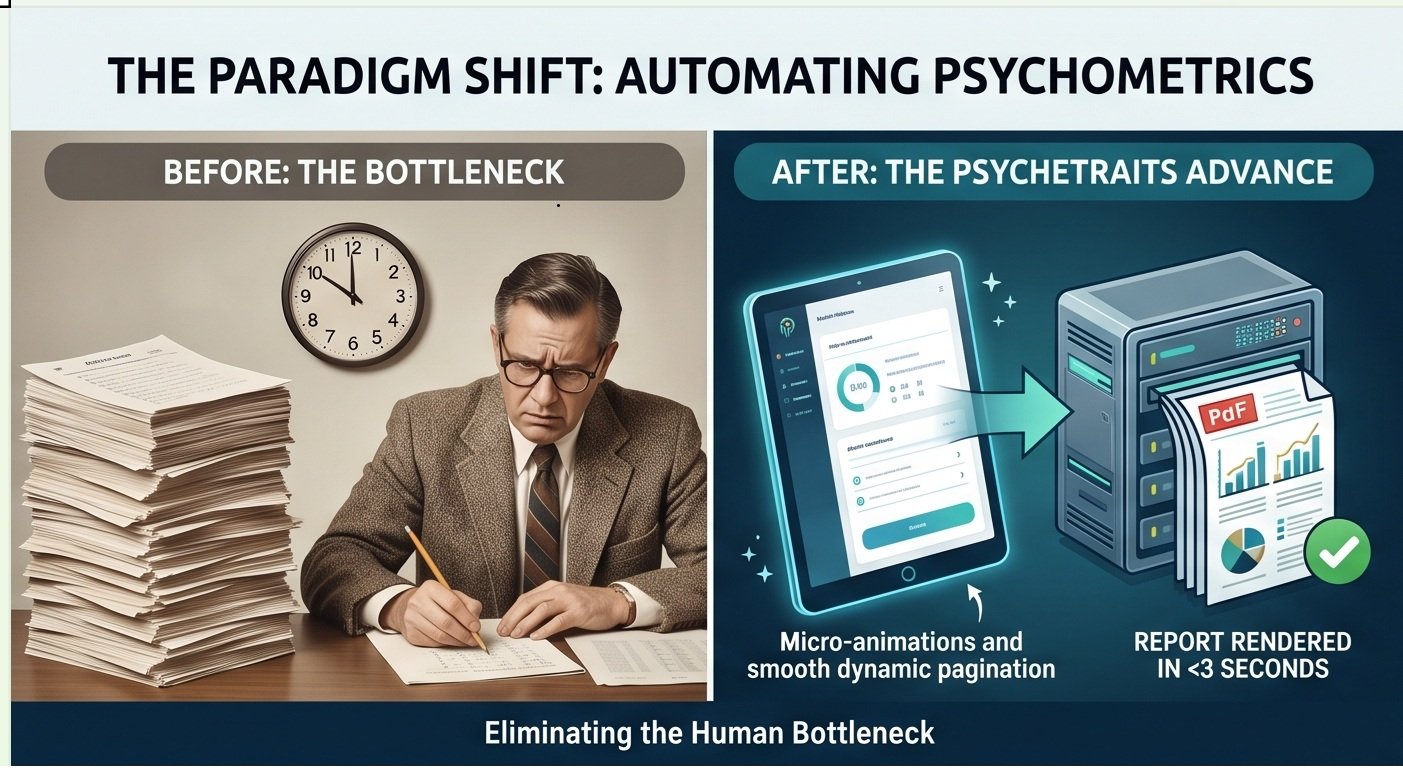

14.13 Granular Security Toggles (Micro-View)

UI Screenshot
Finally, let us aggressively zoom in on the exact mechanism HR utilizes to control this entire flow.
This microscopic view of the HR Dashboard toggles reveals the absolute binary control of the platform. Here, `Show Result` is toggled ON (Green), meaning the candidate is allowed to know they finished the test. However, `PDF Download` is toggled OFF (Grey). This explicit configuration allows HR to say "Yes, we received your test," while legally preventing the candidate from downloading the highly sensitive clinical analysis to their personal hard drive. This granular security is what wins massive enterprise contracts.

14.14 The Finished Clinical Report Interface

UI Screenshot
Once the assessment algorithms conclude, the massive processing payload ends gracefully on the Final Results Profile.
This screen is the ultimate clinical output of the system. Notice that despite the highly complex internal psychology modeling (assessing 7 different dimensions of stress), the UI surfaces it as an incredibly intuitive data digest. It presents structured Risk Alerts (e.g., Clinical Validity Warning), a color-coded subscale table, and a visually striking 'Radar Profile' chart. This ensures that when the HR Director eventually receives this document, they do not need a PhD in psychology to understand it.

14.15 The Ghost Edge Export Mechanism

UI Screenshot
At the absolute peak of the page sits the core technological trigger: the "Print / Save PDF" execution button.
This is not a simple anchor link dropping a file. This button triggers the Zero-Server 'Ghost Protocol' CSS engine. When clicked, it does not send data across the internet. Instead, it signals the browser engine to instantly re-format the entire, highly graphical React DOM element into an isolated, print-optimized canvas.

14.16 Perfect Client-Side PDF Synthesis

UI Screenshot
Following the execution trigger, the final synthesis occurs entirely offline inside the user's local hardware.
This execution screen is the ultimate "checkmate" regarding cloud costs and HIPAA data security. As seen in the generated 7-page PDF dialog, the exact UI has been perfectly converted into an institutional format. Notice the continuous headers/footers, preventing pagination fragmentation. All of this heavy lifting—the graphs, grids, and thousands of words of clinical text—was converted into a PDF strictly using the user's own computer processor. We pay absolutely zero server rendering costs for this action, driving profit margins near 99.9%.

Conclusion of the Execution Flow

Global Psychometric Scale
Every single operation—from the Super Admin's token allocation to the Candidate's final millisecond of PDF generation—is mathematically verified, visually frictionless, and cryptographically secure. This is not a prototype; this is a fully realized, enterprise-grade architecture.

CHAPTER 15: LIVE INTERACTIVE DEMONSTRATIONS

15.1 The 16 Personality Factor (16PF)

https://pharmaexa.com/16pf/
SCAN HERE
Scan QR Code
The 16PF is a globally recognized, aggressive psychometric evaluation used by top-tier corporate HR departments to predict leadership potential, emotional resilience, and corporate culture fit out of millions of applicants.
Clinical Execution Time: ~20 minutes
Live Demo: Scan the QR Code to launch the assessment. Experience the frictionless candidate UI and watch as our browser algorithm instantly traces your psychological input into a secure, multi-page clinical profile.

15.2 The NEO Five-Factor Inventory

https://pharmaexa.com/neoffi/
SCAN HERE
Scan QR Code
The NEO-FFI is the clinical gold standard for measuring the "Big Five" personality traits. It is heavily utilized to mathematically calculate a candidate's Openness, Conscientiousness, Extraversion, Agreeableness, and Neuroticism under high-stress corporate environments.
Clinical Execution Time: ~15 minutes
Live Demo: Scan this QR Code to test the production instance. Note the algorithmic speed as the system calculates your five-factor baseline and renders the complex radar charts to a localized PDF without contacting an external analytics server.

15.3 The Stress Appraisal Measure (SAM)

https://pharmaexa.com/sam/
SCAN HERE
Scan QR Code
The SAM engine executes real-time evaluation of how an individual processes acute stress. It mathematically measures their immediate psychological threat response, perception of control, and cognitive coping mechanisms during high-stakes structural crises.
Clinical Execution Time: ~5 minutes
Live Demo: Access the live link via this QR Code. You will see how our React frontend seamlessly guides users experiencing cognitive overload, finalizing in an exportable clinical chart detailing your specific threat processing mechanics.

15.4 Holmes-Rahe Life Stress Inventory

https://pharmaexa.com/lifestress/
SCAN HERE
Scan QR Code
This assessment calculates mathematical probability models predicting severe, stress-induced physical illness. It forces candidates to inventory life-altering crises within the past 12 months, outputting a highly accurate "burnout threshold" clinical score.
Clinical Execution Time: ~5 minutes
Live Demo: Scanning this code directs you to the live B2C deployment. Experience how the Zero-Trust architecture ensures this highly sensitive medical vulnerability data is compiled exclusively upon your local mobile processor, protecting institutional liability.

15.5 The Adult Hope Scale

https://pharmaexa.com/hopescale/
SCAN HERE
Scan QR Code
This psychological inventory quantifies a subject's "Agency" (goal-directed energy) and "Pathways" (planning to meet goals). It is heavily utilized by executive coaching firms to determine operational resilience and long-term visionary potential in corporate leadership.
Clinical Execution Time: ~3 minutes
Live Demo: Use your mobile camera to scan and trigger the assessment. The resulting Ghost Protocol PDF will explicitly demonstrate how complex psychological theory is translated into simple, visually striking executive intelligence for massive enterprise clients.

15.6 Satisfaction With Life Scale (SWLS)

https://pharmaexa.com/swls/
SCAN HERE
Scan QR Code
The SWLS is the leading global diagnostic for measuring cognitive well-being and general life psychological equilibrium. Unlike temporary emotional state-tests, it forces a deeply rational, mathematical evaluation of an individual's total life trajectory.
Clinical Execution Time: ~3 minutes
Live Demo: Launch the demo using this QR code. Witness firsthand the incredible speed and precision of our client-side psychometric calculation engine as it computes your final clinical report instantaneously upon your final submission click.

15.7 Occupational Stress Index (OSI)

https://pharmaexa.com/osi/
SCAN HERE
Scan QR Code
The OSI is the definitive enterprise diagnostic for measuring complex workplace burnout. It quantifies localized corporate stress across 12 distinct psychological sub-scales, including role ambiguity, political pressure, and intense workload volume, allowing HR to predict turnover before it happens.

Clinical Execution Time: ~15 minutes
Live Demo: Scan the QR Code below. See exactly how the platform processes 46 complex clinical questions instantly, converting raw user input into a massive 12-factor corporate stress matrix PDF directly upon your mobile device.

"What was once invisible is now measurable.

PSYCHETRAITS turns human complexity into clear, actionable intelligence."

Thank You
For your time and consideration.
Logo

PSYCHETRAITS

Measuring the Human Mind at Scale.

We are actively opening funding rounds to aggressively scale PsycheTraits into global university networks, manufacturing conglomerates, and hospital systems. For seed-stage or Series-A investment discussions, please connect with the lead architect and founder below.

Investment Inquiries
Lead Architect: Usman
Direct Line: +91 6303569748
Email Auth: khanusk123@yahoo.com
© 2026 PharmaExa SAAS Ecosystem — All Rights Reserved.
1 / X